
Slipway & haul-out
Slipway Haul-Out Kendari: Methods, Tides and Scheduling
This page explains the slipway haul-out methods available in Kendari and Southeast Sulawesi, how slots are scheduled, the haul-out procedure we supervise, and an outline of the costs. For the full map of every facility, start with the Kendari shipyard and docking guide.
- 2
- Main haul-out methods
- Days–weeks
- Queue outside peak season
- Tide
- Scheduling follows the water
- In writing
- Slots locked in early
Short answer
To book a slipway haul-out in Kendari, send your vessel data (type, LOA, GT, material, draft) via WhatsApp. We verify which facility has matching capacity — a city slipway or the Moramo–Lapuko yard cluster — then lock in the date around the Kendari Bay tidal window. Haul-out usually happens within days to a few weeks, depending on seasonal queues.
Methods
Available haul-out methods
-
Rail slipway
The most common method at local facilities: the vessel is hauled up on a cradle that runs on rails, driven by a winch. Its advantages: the vessel sits stable, access under the hull is good, and it suits full hull work. Its limits lie in winch capacity, rail strength and cradle width — which is why we always run a technical check of the facility before booking.
-
Airbag launching/haul-out
The airbag method uses pressurized rubber balloons rolled under the hull on a gently sloping beach. It is flexible and needs no permanent rails, so it is widely used by traditional boatyards. For wooden vessels, airbags demand careful calculation of support points so that the planking and frames are not overloaded; our supervisor checks the number and position of the airbags against the vessel’s weight and construction.
Gallery
Vessels on the cradle
Once the vessel is out of the water and dry, hull work can begin. These two photos show the very first and the very last stages of out-of-water work.
-
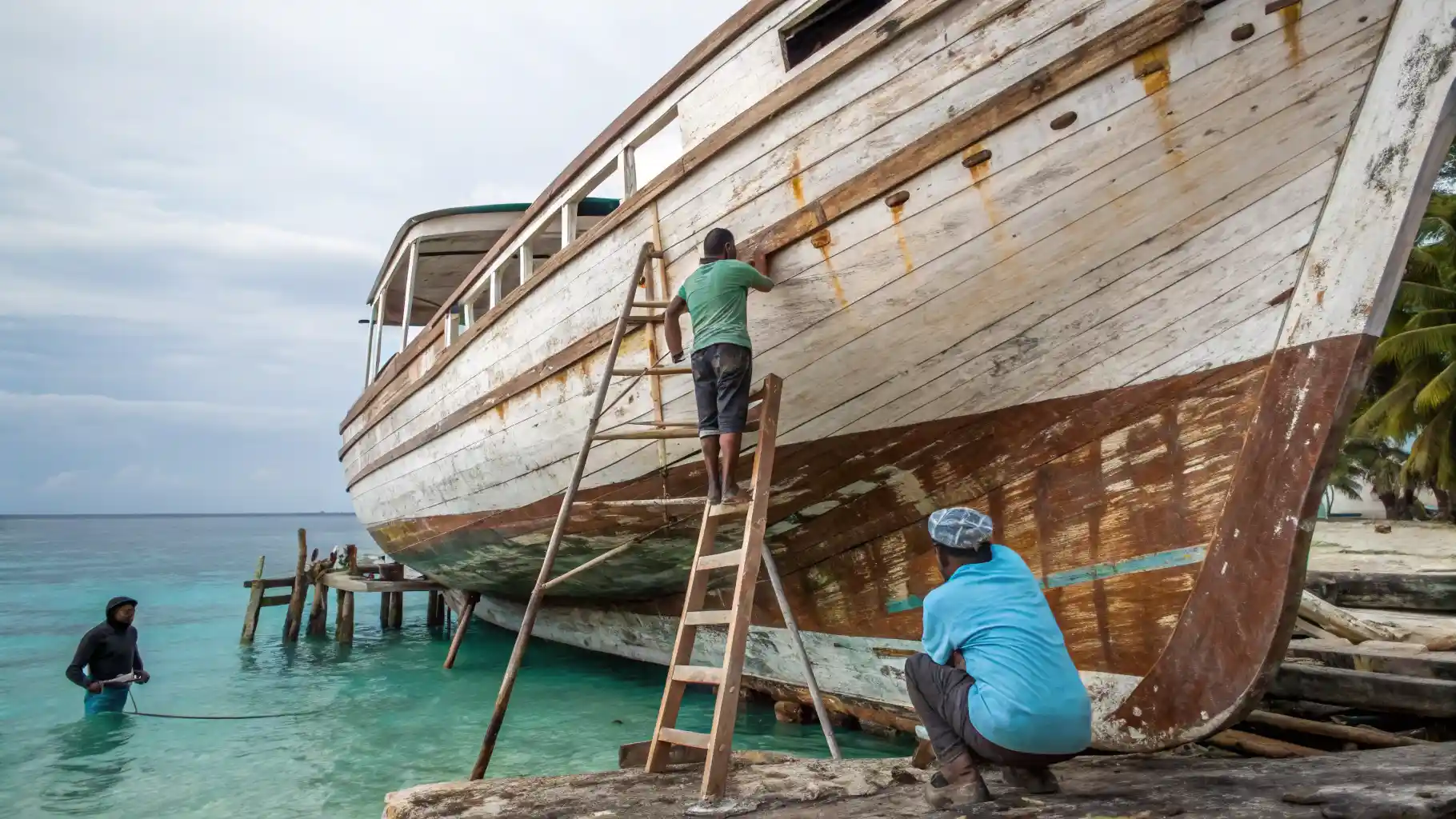
The hull is scraped and sanded once dry -
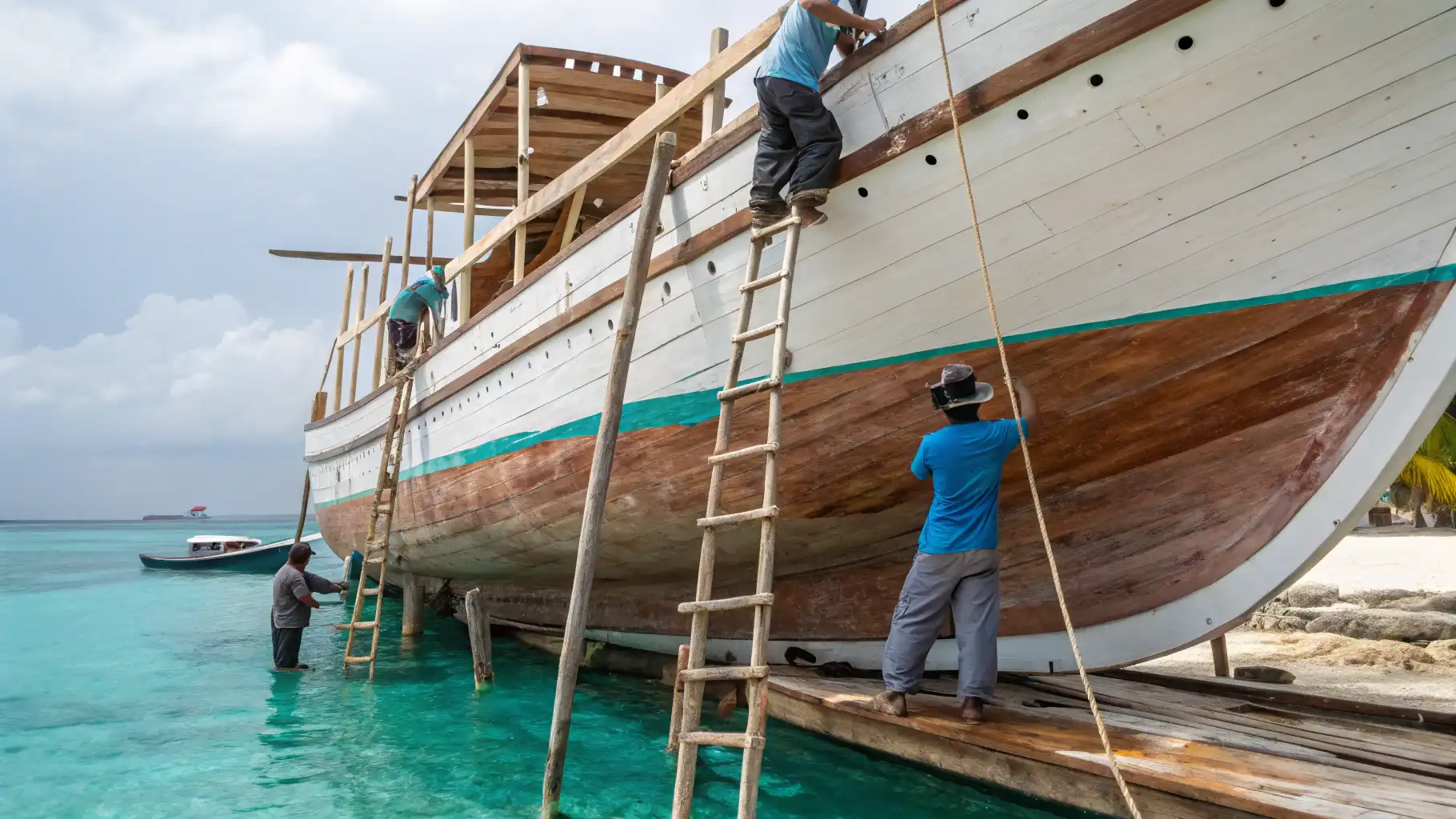
Protective coatings reapplied before relaunch
Method fit
When each method is used
| Vessel class | Usual method | Notes |
|---|---|---|
| Speedboats & small craft <10 GT | Beach hauling, trailer, small airbags | Fast, low cost |
| Fishing vessels 10–100 GT | Rail slipway / airbag | Choice depends on facility & scope |
| Tugboats & workboats | High-capacity rail slipway / airbag | Winch capacity check mandatory |
| Barges | Airbags on a large yard area / large dock | Limited local options; often afloat |
| Steel vessels >1,000 DWT | Large eastern-route dock | Kendari = planning base |
Scheduling & procedure
Tidal windows, haul-out procedure and costs
Kendari Bay tidal windows & scheduling
Kendari Bay is relatively sheltered, but hauling out and refloating still follow the tide: vessels are hauled out at high water so that the cradle or airbags have enough depth. In practice, each month brings full-moon (spring) and neap tide windows that are the favored slots; queues build up ahead of the fishing season and ahead of the end of the fiscal year for government vessels. We schedule backward from the tidal window: materials are ordered first and labor is locked in, so dock days are not wasted waiting for parts.
The haul-out procedure we supervise
Before the vessel comes up, we check the blocking plan: support positions relative to bulkheads and tanks, keel condition, and lifting points that are safe for your vessel’s construction. During hauling, the supervisor monitors winch line tension, the vessel’s position on the cradle and rail alignment. Once the vessel is seated, a joint initial inspection follows: the hull condition is photographed as a baseline, the work area is cleaned, and the scope is reconfirmed before work begins. The same pattern applies at relaunch — including a leak test before the vessel is released from the facility area. The full workflow from assessment to handover is on our how-it-works page.
Vessel types we handle on the slipway
Wooden and fiberglass fishing vessels, tugboats, small barges, speedboats, patrol vessels and mining workboats are the main users of Kendari’s slipways. Each type has different damage patterns and needs — wooden fishing vessels need a regular caulking and antifouling cycle, tugboats need attention to propulsion and stern plating, speedboats to gelcoat and fuel lines. Details per vessel type are on the vessel types we service page. For fleets operating far to the east — Wakatobi and Banda — we align haul-out scheduling with the operating season; see eastern-route fleet support.
Slipway costs
The cost components are: haul-out and refloating (one-off), dock-day rental (per day), and repair work (per item). As a guide, hauling out a 30 GT fishing vessel at a local facility generally falls in a band from several hundred to around two thousand US dollars for haul-out and refloating plus standard dock days, excluding work. Larger vessels, special cradles or difficult hauls push the figure up. The full bands per size class, quotation components and how to compare quotations between facilities are in our Kendari docking cost guide (USD).
Why go through our desk
Slipway slots in Southeast Sulawesi are not centralized: each facility has its own schedule, capacity and standards. Without someone on the ground, owners often face slipping schedules or a vessel seated on the wrong cradle. We lock in slots in writing, verify facility readiness the day before hauling, and place a supervisor on site while the vessel is ashore. Contracts and payments run through PT Komodo Galangan Nusantara with a structured USD quotation.
Checklist
Our desk’s pre-haul-out checklist
Before the hauling date, there is homework that decides whether the whole project runs smoothly. On the vessel side: fuel and water tank contents are known (the actual weight affects the hauling calculation), cargo and ice are unloaded, loose items on deck are lashed, and the vessel’s documents are ready to show if the facility or the authorities ask for them. On the facility side: the condition of the rails and cradle is checked in person by our supervisor, winch and wire capacity is checked against the vessel’s weight, support positions are mapped against the hull construction, and the work area is agreed — including power points, working water and material routes. On the weather and water side: the tidal window is chosen, wind direction is factored into the approach maneuver, and a backup plan is prepared in case conditions change.
On the day, the vessel approaches at minimum speed and is positioned precisely over the cradle by the facility team, with our supervisor verifying alignment before hauling begins. Hauling proceeds in stages, with a check at each pause. Once the vessel is fully seated, the blocking is rechecked, the hull is rinsed with fresh water while the fouling is still wet — saving hours of cleaning — and baseline documentation is taken. These small disciplines are what separate a haul-out that finishes on schedule from one that runs a week late.
FAQ
Frequently asked questions
What is the maximum vessel size that can haul out on a slipway in Kendari?
City coastal slipways generally serve vessels up to roughly 30–100 GT, while the strongest facilities in the Moramo–Lapuko yard cluster can handle wooden and light steel vessels up to roughly 100–300 GT, depending on rail and winch condition. Beyond that — especially steel vessels above 1,000 DWT — the realistic option is a large dock on the eastern route, with Kendari as the planning base.
Rail slipway or airbag — which is safer for a wooden vessel?
Both are safe when done properly. A rail slipway spreads the support more evenly through the cradle, so it suits older wooden vessels or those with weak frames; airbags are more flexible but demand careful calculation of support points. Our recommendation follows the vessel’s actual structural condition — which is what the supervisor’s pre-haul-out inspection is for.
How long is the usual queue for a slipway slot?
Outside peak season, a slot can be secured within days to one or two weeks. Ahead of the fishing season and the end of the fiscal year, queues can stretch to several weeks. We track the schedules of several facilities at once and lock in slots in writing early, so your vessel is not waiting at anchor burning idle costs.
Can a coal barge be hauled out in Kendari?
Local options for barges are limited: they need a large airbag yard area and high hauling capacity that not every facility has. Much barge scope — topside plate welding, fender replacement, winch repair — can be done afloat in Kendari; for major replating below the waterline, we direct the barge to an adequate facility on the eastern route and continue to supervise the work.
Where to go from here
Book a slipway slot
Compiled by Kendari Shipyard Desk — a specialist maritime brand under Juara Holding Group. Contracts via PT Komodo Galangan Nusantara.