
Fleet maintenance contracts
Fleet Maintenance Contracts & Fleet Docking in Kendari
A fleet maintained reactively — break down first, then look for a workshop — always pays more: emergency prices, uncertain slots, idle vessels. Fleet maintenance contracts reverse that logic. This page explains the model, who it is for, and how to get started.
- 3
- Vessels are enough for an integrated calendar
- 3
- Contract models
- 12 mo
- Docking and service calendar
- Locked
- USD unit rates
Short answer
Fleet maintenance contracts are annual agreements between a vessel operator and our desk: scheduled dry docking for every vessel, a call-off repair line when damage occurs, USD quotations with a locked structure, and a condition report per vessel. They are designed for passenger, logistics and fishing operators and government agencies with fleets in Southeast Sulawesi and on eastern routes.
Models
Three contract models
-
Scheduled annual docking
The basic model: every vessel in the fleet gets an annual dry-docking date locked in at the start — slipway slots are booked in advance, a standard scope (cleaning, antifouling, zinc anodes, propulsion inspection) is fixed, and materials are ordered before the vessel is hauled out. From January the owner knows when each vessel will stop and what the budget is.
-
Call-off repair
On top of the annual schedule, the contract provides a call-off line: when damage occurs outside the schedule, contract vessels get priority mobilization of technicians and slots, at the unit rates already agreed in the contract — not emergency prices. Its value is felt most in the busy season, when non-contract vessels queue for weeks.
-
Full planned maintenance
The most complete model: we hold the maintenance calendar for the whole fleet — dry docking, periodic engine servicing, class and statutory survey cycles, component replacement based on running hours — and execute it throughout the year with regular reporting. The owner only decides the big items; maintenance operations run on their own. A similar pattern is used in managing commercial charter vessels, where year-round technical management keeps the vessel ready to sail at all times — the same principle we apply to working fleets.
Gallery
Maintenance that runs to schedule
A maintenance contract keeps small jobs small. These two photos show the work that most often goes into the monthly schedule.
-
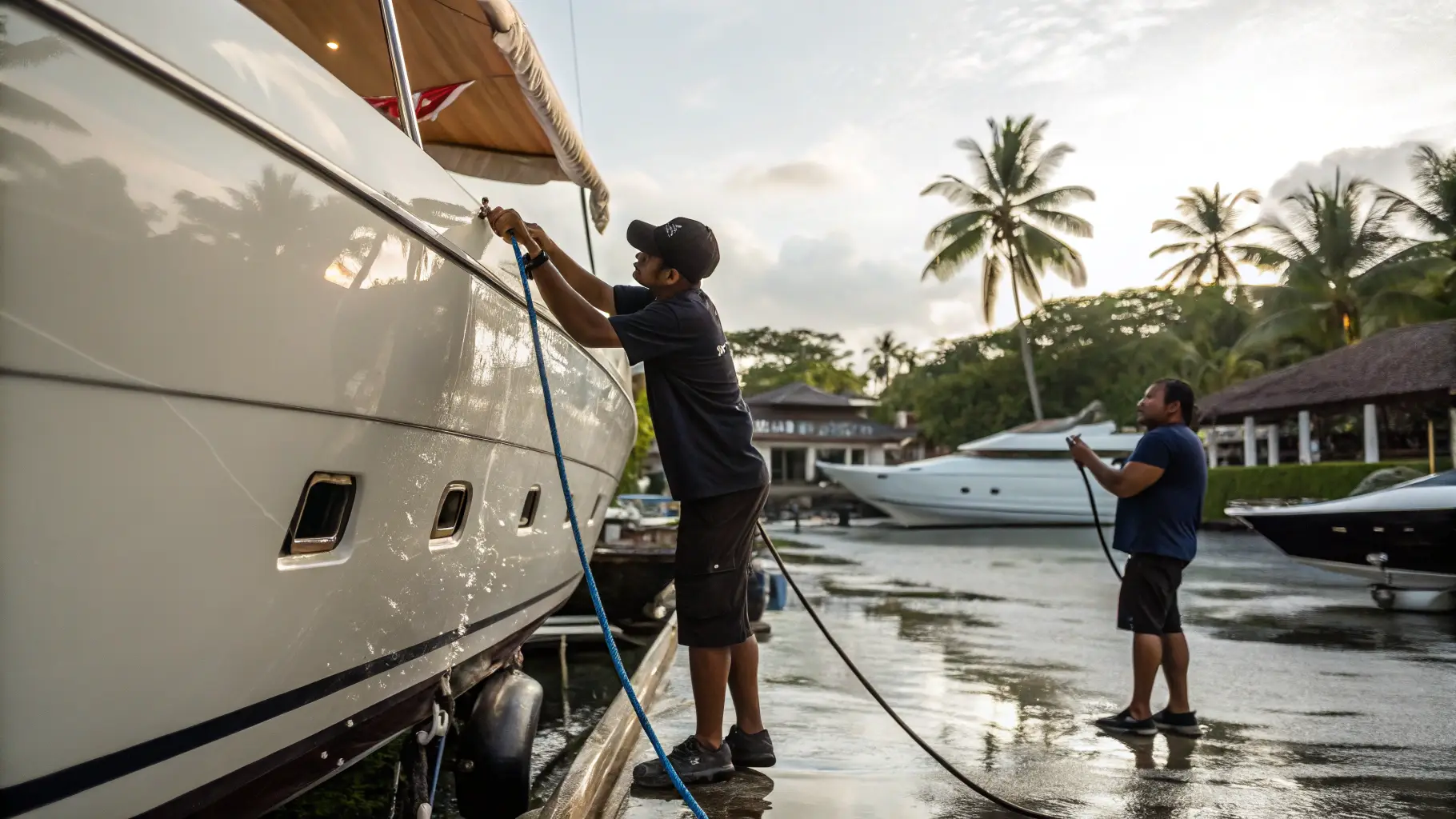
Periodic hull washing and inspection -
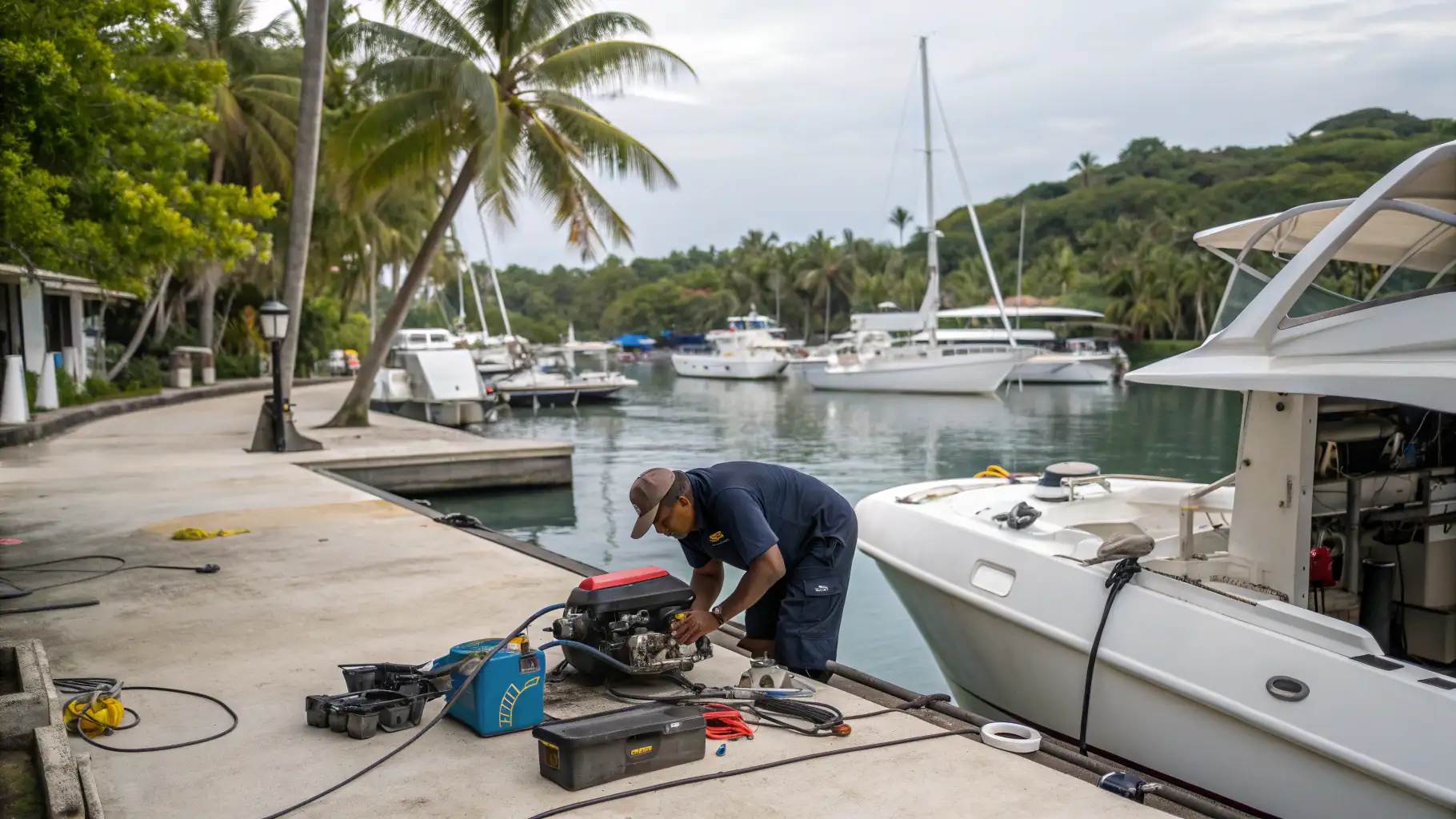
Scheduled engine component maintenance
Users
Which operators it suits
Four main user profiles.
-
Local passenger operators
Bound by statutory schedules and unable to stop without warning.
-
Tugboat and barge logistics operators
Serving the nickel mines of Southeast Sulawesi, with penalties for delays.
-
Fishing companies
Many vessels, with docking cycles that have to follow the fishing seasons.
-
Government agencies and departments
Patrol vessels or workboats procured through a tender process.
Scenarios for eastern-route tourism fleets — dive boats in Wakatobi and the surrounding area — are covered separately under Wakatobi and Banda fleet support.
Cycle
One contract cycle, from the start
-
Fleet inventory
01
Data on each vessel, initial condition, certificates.
-
Calendar planning
02
A twelve-month docking and service calendar, aligned with the operating season.
-
Rate agreement
03
Unit rates and a budget band per vessel in USD.
-
Execution throughout the year
04
Scheduled dry docking, call-off when needed, regular reports.
-
Year-end review
05
Actuals vs plan, and adjustment of the next year’s calendar.
The per-item cost structure follows the same framework as the docking and repair cost guide; the detailed workflow is in how we work.
Tenders and reporting
Document support and per-vessel reporting
Tender and document support
For formal procurement, we prepare the document package the tender committee needs: technical work specifications, a structured RFQ, an execution schedule and work-method references. Contracts and quotations run in the name of PT Komodo Galangan Nusantara as the legal entity. We frame it honestly: we are a provider of dry-docking and repair coordination and supervision — our strength is making sure the tendered work is actually carried out to specification, with complete documentary evidence.
Reporting: vessel condition, work history, USD budget
Every contract vessel has a living file: the latest condition per system (hull, engines, propulsion, electrical), work history with photos, components approaching the end of their service life, and budget actuals against plan. Reports are sent regularly and are available whenever the owner asks. The long-term benefit is real: a vessel with a documented history is easier to insure, survey and sell at a good price.
Getting started
Starting a contract: the fleet audit as the foundation
Every maintenance contract we run starts with a fleet audit — because a calendar and a budget are only as good as the data underneath them. The audit is practical, not ceremonial: each vessel is checked for hull condition (including the last docking history and photos if available), main engine and genset running hours against the service schedule, propulsion condition from the latest vibration and clearance records, the status of electrics and alarms, and the validity of every certificate.
From that foundation, the contract runs to a predictable rhythm: scheduled work is executed on the calendar, new findings come in through the call-off line at rates already locked, and monthly reports update the condition map. At year end, actuals are compared with the projection — and from the gap we learn how to tune the next year’s calendar. Operators who go through this cycle for two or three years generally see the same pattern: emergency costs fall sharply, asset life is extended, and — most noticeable in daily operations — vessels stop at the planned time, not at the most damaging time.
The minimum contract size is not rigid: three vessels are already enough to feel the benefit of an integrated calendar, and a fleet of one or two vessels can still use the same working pattern without committing to a full calendar. What matters is not the number of vessels but the willingness to manage maintenance as a plan — not as a series of surprises. Start with a fleet audit; from there the numbers speak for themselves.
FAQ
Frequently asked questions
How is a docking quotation structured for a 100 GT vessel?
A proper quotation is broken down by item: haul-out and refloating, dock days, cleaning and surface preparation, painting per m², replating or timber work per unit, propulsion work, and statutory items with official IDR fees written separately. This structure is what makes quotations comparable between facilities — and it is what we lock in as unit rates in a fleet contract.
Can a contract cover vessels spread across several ports in Southeast Sulawesi?
Yes — that is exactly the strength of the call-off model with a Kendari base: vessels in Kolaka, Baubau, Wakatobi or the mining ports are still covered, with teams mobilized for afloat work on site and dry docking centralized at the facilities in Kendari and the Moramo–Lapuko yard cluster according to each vessel’s schedule.
Can you act as a partner for a government docking tender?
Contracts and quotations run through PT Komodo Galangan Nusantara, and we prepare the technical support and documents the procurement process requires. We frame it honestly to the committee: the service offered is facility coordination and work supervision with full documentation — whether each tender’s administrative requirements are met is assessed case by case.
What is the advantage of an annual contract over paying per incident?
Three measurable things: priority slots (your vessel does not queue at the back in the busy season), locked prices (unit rates agreed up front, not emergency prices), and less idle time (materials and technicians ready before the vessel stops). Plus one that is often forgotten: a documented maintenance history that raises the value of your fleet.
Continue from this page
Discuss a fleet contract
Start with a fleet audit; from there the numbers speak for themselves.