
Electrical & systems installation
Marine Electrical Repair & Systems Installation in Kendari
Electrical faults are the most frequent source of breakdowns on small and medium vessels, and the most common cause of vessel fires. This page sets out the marine electrical repair scopes we coordinate in Kendari and the standards we hold them to. The map of supporting facilities is in the Kendari shipyard guide.
- 12
- Pre-season audit points
- ½ day
- Audit duration
- COLREG
- Navigation light reference
- Marine
- Cable standard
Short answer
Marine electrical repair in Kendari covers main switchboard and distribution repairs, protection and grounding, navigation lights installed to the rules, instrument wiring, winch and pump systems, bilge alarms, and cable rework to marine standards, plus fuel and fresh-water piping — done afloat or while the vessel is on the dock.
Scope
Switchboards, navigation, electromechanical systems & piping
-
Main switchboard repair
A switchboard extended piece by piece for years without documentation is a common sight in local fleets: breakers that do not match the load, loose connections running hot, and circuits nobody can identify. Our repair starts with mapping: every circuit is identified and labeled, loads are measured, breakers are resized, and connections are tightened and given a simple thermal check. The end result is not just a working switchboard but a simple single line diagram that becomes part of the vessel’s documents.
-
Protection & grounding
A vessel’s DC and AC systems need proper protection: fuses or breakers as close to the source as possible, cable sizes matched to load and run length, and correct grounding and bonding. Poor grounding is not only a shock hazard — stray current accelerates galvanic corrosion of the hull and propeller. If your vessel eats through its zinc anodes too quickly, the electrical system is often the prime suspect.
-
Navigation & communication systems
Navigation lights are installed in line with COLREG and national rules: color, arc of visibility, visible range and position according to vessel type and size. We also handle instrument wiring — GPS, echo sounder, radio — routed separately from power cables to avoid interference, with proper voltage protection. For vessels due for survey, a complete set of navigation lights is a standard inspection item; see also our support for class surveys by BKI (Biro Klasifikasi Indonesia, the Indonesian Classification Bureau) and certification.
-
Electromechanical systems: winches, pumps, bilge
Anchor winches and fishing winches, seawater and fresh-water pumps, and bilge pumps with float switches and alarms — all systems that combine a motor, controls and protection. An undetected bilge pump failure is one of the classic ways vessels sink at the berth; we install independent bilge alarms with a documented function test. A new winch installation is most efficient during a docking window — its foundation often needs fabrication and welding work.
-
Cable installation rework
The standards we hold to in a humid, salty marine environment: marine-grade cable, or at minimum flexible stranded double-sheathed cable (not rigid building wire); terminations with properly crimped cable lugs (not twisted wires wrapped in tape); cable runs tied down and protected from chafing; sealed junction boxes for connections in wet areas; and every circuit labeled. A complete rework on one vessel is usually finished within days and immediately cuts the rate of recurring faults.
-
Fuel & fresh-water piping installation
As one package with the electrical work, our team handles fuel lines from tank to engine — with the correct filters, water separator and valves — as well as fresh-water lines and their pressure pumps. Fuel lines use metal pipe or certified fuel-resistant hose with double clamps; the still-common practice of using ordinary water hose for fuel is a fire risk we refuse. Pipe replacement that penetrates the hull is scheduled together with a slipway haul-out.
Gallery
Electrical work on board
A vessel’s electrical installation is judged by the neatness of its cable runs, the quality of its terminations, and the documentation left for the next technician.
-
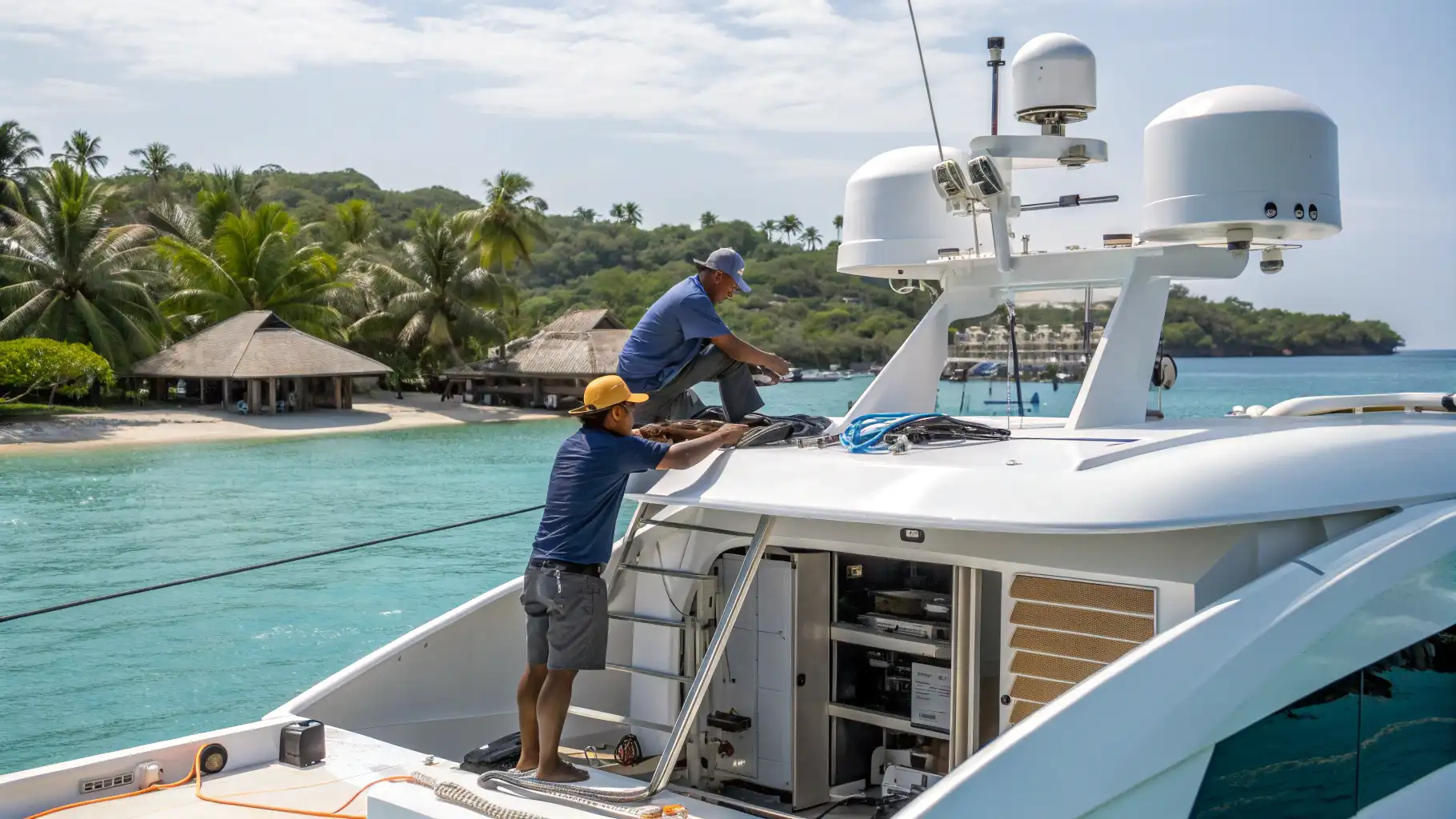
Installing electrical and electronic circuits -
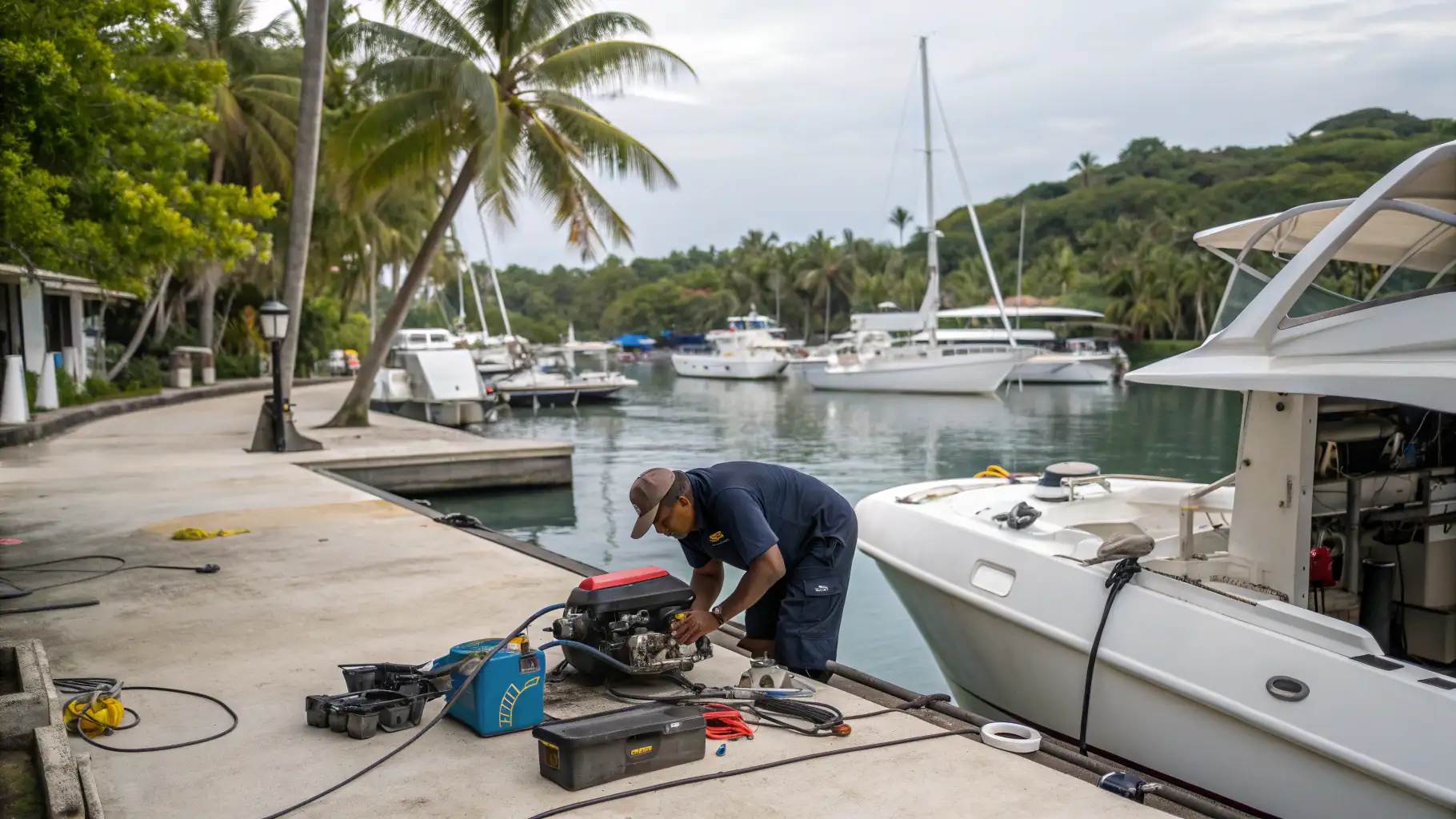
Checking components and support systems
Cost
How electrical work is quoted
Electrical work is quoted per scope: switchboard mapping and repair, rework per vessel, and installation per point or per system. USD orientation and how to read a quotation are in the docking & repair cost guide. Every material is listed by brand in the quotation — you know exactly which cables and components are installed.
Audit
12-point electrical audit before the operating season
Most vessel fires and electrical breakdowns can be prevented by a half-day audit. The audit produces a ranked list of findings: hazards are fixed now, deteriorating items are scheduled, and healthy items are recorded as a baseline. For vessels operating far from a workshop — Wakatobi and Banda fleets and the small ports of Southeast Sulawesi — an audit like this before departure costs far less than a single electrical breakdown at sea. The audit can be done afloat at any berth in our service area.
FAQ
Frequently Asked Questions
The vessel’s power keeps tripping at sea — where should diagnosis start?
In this order: first the switchboard — find the tripped breaker and the loads on that circuit; second the loads — disconnect them one by one to find the one leaking current; third the insulation — measure the insulation resistance of suspect circuits, especially those running through wet areas. Recurring faults are almost always rooted in a wet connection or a damaged cable on a hidden run — not in the breaker that keeps being replaced.
Do navigation light installations have to follow specific rules?
Yes. COLREG (the International Regulations for Preventing Collisions at Sea) and national rules set the color, arc of visibility, visible range and position of the lights according to vessel type and length. A vessel with non-compliant lights can fail an inspection by the Syahbandar (harbor master) or a survey. We install to the rules and document the light positions.
Can a new winch be installed during docking?
Yes, and that is actually the most efficient approach: the winch foundation is fabricated and welded while the vessel is on the dock, the power cable is pulled alongside other work, and a load test is done before the vessel is refloated. One dock window completes the structural, electrical and mechanical work together — no doubled dock days.
What cable standard should be used on a vessel?
Ideally marine-grade cable: fine-stranded tinned conductors, oil- and heat-resistant insulation, and a double sheath. Building wire with solid cores breaks easily under vibration and corrodes in a salt environment — a source of faults and fires. During a rework, if the budget is limited we replace critical circuits first, prioritizing fuel, charging and bilge circuits.
Where to go next
Request an electrical audit
Written by Kendari Shipyard Desk — a specialist maritime brand under Juara Holding Group. Contracting entity: PT Komodo Galangan Nusantara.