Stalled vessel completion is the process of taking over a shipbuilding project that has stopped and finishing it to a seaworthy, certifiable standard. Kendari Shipyard runs this work from Kendari, Southeast Sulawesi, Indonesia, on both timber and steel hulls, in a fixed order: survey, document audit, remaining scope, then contract.
Why Indonesian builds stall
Foreign owners often assume a stalled build means poor craftsmanship. In practice the craftsmanship is rarely the failure point. Three structural causes account for most cases we examine.
The first is payment terms tied to the calendar rather than to physical progress. A yard that has already been paid for month five has no commercial reason to deliver month five, and the gap compounds silently until the project stops. The second is undefined scope. The owner believed the price covered interior joinery, electrical fit-out, sea trials and certification; the yard believed it covered a hull with an engine installed. Neither party wrote it down, so both are right. The third is unhedged material cost. A fixed price agreed in one steel or ironwood market, with no adjustment clause, quietly becomes unbuildable when that market moves.
None of these are engineering problems, which is why the recovery cannot begin with welding. It begins with reading what actually happened.
The four-stage takeover
1. Independent condition survey
We record what exists, not what was promised. On steel hulls that means ultrasonic thickness measurement across shell plating, decks, bulkheads and any area that has held standing water, plus assessment of deformation, hidden corrosion and the quality of existing welds. On timber hulls it means examining keel, frames, planking, fastenings and joints, with exploratory opening at suspect points to check for rot and marine borer activity. Loose material on site — plate, timber, engines, gensets, shafting — is inventoried separately, because ownership of that material is frequently disputed later.
2. Document and legal audit
We trace the original contract, proof of payments, design drawings, class approval status if any, and the vessel’s measurement and registration position. A surprising number of builds are stalled on paper rather than in steel: drawings were never approved, so nothing built against them can be classed. What that means in practice is set out on our BKI class and Indonesian ship certification page.
3. Remaining scope and pricing
Those two stages produce a single document: every outstanding work item, with measured quantities. Only then does a number appear. How we structure that number so the same failure does not repeat is explained under cost, payment terms and escrow protection.
4. Execution against evidence
Work proceeds with dated photographic records and a signed completion note per milestone. Payment releases only after a milestone is verified. If an item cannot be photographed and signed for, it is not treated as complete.
When we advise you to stop
The hardest part of this work is saying no. Some hulls genuinely cost more to rescue than to rebuild — typically timber hulls that have stood several wet seasons without a roof, or thin steel hulls where corrosion has crossed minimum-thickness limits across too many panels. When the arithmetic says that, we say it plainly and point owners toward a fresh new build or toward buying a completed vessel after a proper condition survey and valuation.
Typical vessels we are asked about
| Vessel type | Common stall point | Governing check |
|---|---|---|
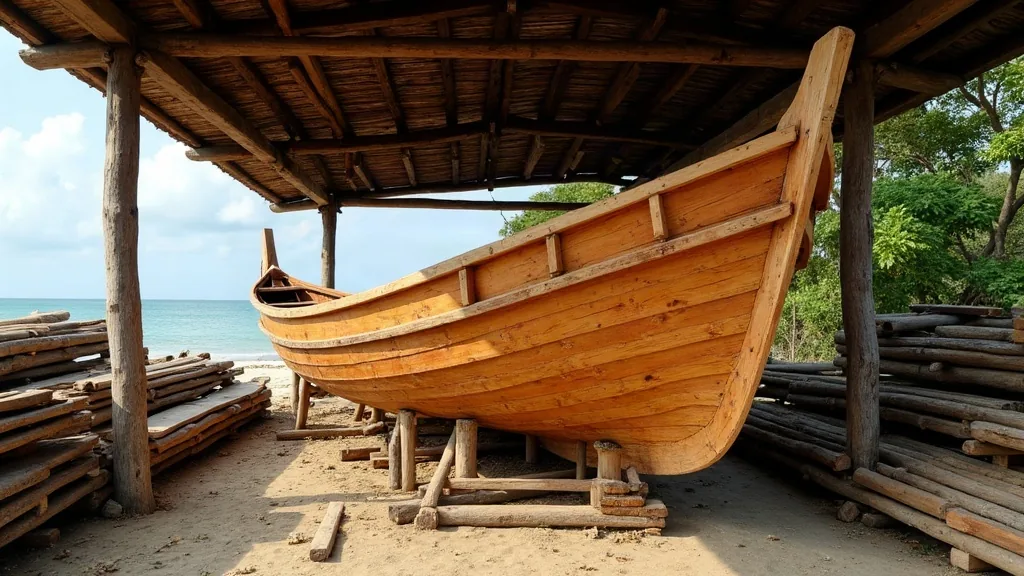
| Phinisi / timber liveaboard | Hull planked, no deck or interior | Frame and fastening condition |
| Steel tug or landing craft | Shell complete, no machinery | Plate thickness and weld quality |
| Fishing vessel conversion | Stripped, no rebuild plan | Stability after layout change |
| Crew boat / fast aluminium | Structure done, systems missing | Weight budget and trim |
Timber-hull specifics, including phinisi work in a Southeast Sulawesi context, are covered on our phinisi and timber hull page. Steel workboat and barge programmes sit under tugs and barges.
Stopped is not the same as failed
Not every halted build has failed, and separating the two saves considerable money. A project stopped by the yard’s cash position can often be recovered where it stands, through restructured terms, re-verified progress and instalments tied to physical evidence. A project stopped because the yard lost its workforce or technical capability usually has to move, since no payment structure can substitute for skills that are no longer there.
A third category is the hardest: builds that stopped because the vessel as specified could never be completed on the hull that was actually built. This happens when the accommodation or equipment plan is too heavy or too large for the structure underneath it. Adding money changes nothing here until the design itself is corrected.
Our assessment phase is built to separate these three cases first, because the correct action for one is wasted expenditure on another.
What the owner receives at the end of assessment
Assessment produces a file the owner keeps and can use regardless of whether the completion work proceeds with us. It contains the condition report with measurement data and dated photographs; an inventory of materials on site with their ownership position; a summary of the documentation position and what can still be verified; a measured list of outstanding work; and three costed scenarios side by side — continue in place, relocate, or stop.
We hand that file over in full deliberately. An owner holding complete data can negotiate with anyone, including with us, and that is precisely what makes the resulting agreement hold. An assessment only its author can interpret is not an assessment; it is a sales instrument.
Working with owners who are not in Indonesia
Most stalled builds we are asked about belong to owners living elsewhere, which changes how the work has to be run. Progress evidence is issued as dated photographic sets against a written work list rather than as narrative updates. Milestone verification is scheduled so an owner’s representative can attend or review remotely before payment releases. Material inventories are recorded at handover and re-checked, because remote owners carry the highest exposure on materials they have paid for but cannot see.
Owners who cannot travel should appoint an independent representative rather than rely on the yard’s own reporting. That applies to us as much as to anyone else; a completion contract that cannot survive independent inspection is not one worth signing.
Starting the conversation
If a build of yours is stopped right now, three actions are worth more than any quotation: secure physical access to the hull, gather every payment record and message thread, and suspend further payments until an independent party has verified condition. Technical discussion should follow that, not precede it. Reach us through the contact page. The Indonesian-language version of this service sits at penyelesaian kapal mangkrak.
Frequently Asked Questions
Can you take over a build started by a different Indonesian yard?
Yes. Taking over stalled builds is our core specialisation. Work begins with an independent condition survey and a document audit, and no contract value is issued until the remaining scope has been measured item by item.
What if the original builder never issued approved drawings?
That is the most common situation. We rebuild an as-built drawing set by physically measuring the hull, mapping frames and bulkheads, and reissuing working drawings that reflect the vessel that actually exists rather than the one that was planned.
Is a hull that sat idle for years still worth finishing?
Often yes, but only data decides. For steel, ultrasonic thickness measurement across plating and internals governs the answer; for timber, the condition of keel, frames and fastenings after exploratory opening. We recommend stopping when recovery cost exceeds new-build cost.
In what currency are contracts issued?
All quotations, milestones and contract values are stated in USD. Construction, repair, refit and vessel-sale contracts are issued by PT Komodo Galangan Nusantara.
Can the hull be moved from the original yard to Kendari?
Yes, and it is frequently the healthiest option. Moving a partially built hull requires the previous yard’s claim to be settled or secured in writing, documented pre-move condition, a lift or tow method matched to hull stiffness, movement permits and transit insurance.