
Dry Docking Kendari vs Makassar: Running the Numbers

For vessels working Southeast Sulawesi, Wakatobi or the Banda Sea, the dry docking Kendari vs Makassar comparison almost always favors Kendari on total cost, provided vessel size and scope fit local capacity. The real cost is the dock rate plus round-trip positioning fuel plus non-earning days; the last two are most often forgotten and both balloon crossing the Makassar Strait.
Kendari Shipyard Desk prepared this article to help owners and operators run the numbers with a cool head: when dry docking in Kendari is enough, and when it genuinely makes more sense to mobilize the vessel to a large dock such as Makassar.
The right formula for total dry docking cost
Whenever we compare dry docking locations, we use one simple formula:
Total cost = dock rate & work + round-trip mobilization fuel + (days lost × daily operating value) + crew costs during mobilization.
Dock rates in a big city can look more competitive on paper. But for a Kendari-based vessel, sailing to Makassar means going the long way round, through the straits and the waters off southern Sulawesi — in our planning practice we count roughly 2–4 sailing days one way, depending on vessel type, weather and the route taken. That means 4–8 sailing days round trip before a single job has started.
Simulation: a 30 GT fishing vessel and a harbor-class tugboat
A 30 GT wooden fishing vessel based at Kendari Ocean Fishing Port (PPS Kendari)
For routine maintenance — caulking, planking inserts, antifouling, anode replacement — the city slipway facilities and the Moramo–Lapuko yard cluster are adequate. Mobilizing to Makassar adds hundreds of liters of fuel per sailing day plus crew logistics, while the value of the work itself may be only a few thousand dollars. In this class, sailing a long way for routine work can almost never be justified economically.
Mining support tugboats
A tugboat serving nickel barge routes has a different calculation: its daily charter value is high, so every idle day is a real loss. If the scope is engine, electrical or welding work above the waterline, afloat repair in Kendari cuts lost days drastically. The vessel only needs a large dock when there is underwater work that local facilities cannot handle — for example, extensive replating to class requirements.
Decision table by vessel size and type of work
| Vessel size / type | Work scope | Recommended location |
|---|---|---|
| Wooden / fiberglass vessels up to ±100 GT | Routine maintenance, hull, paint | Kendari (city slipway / Moramo–Lapuko) |
| Small steel vessels, tugboats | Engine, electrical, welding above the waterline | Kendari (afloat / local haul-out) |
| Small–medium steel vessels | Limited replating, survey | Kendari if capacity allows; verify first |
| Steel vessels >±1,000 DWT | Class renewal (special) survey, major replating | Large docks on the eastern route (including Makassar) |
The figures in the table are planning guidance, not official facility limits. Before deciding, we always verify a facility’s actual condition against the vessel’s data.
Factors often missed in the comparison
First, slot queues. Large docks have their own queues; a vessel can arrive in Makassar and then wait for days. Second, mobilization weather risk — in the strong-wind season the crossing windows narrow, and single-voyage insurance needs to be considered. Third, supervision costs: sending an owner’s surveyor or representative to another city for one to two weeks is not a small expense. Fourth, follow-on work — new findings in dock are far easier to negotiate when the owner or their supervisor is present every day, which is more realistic in the vessel’s own home port.
When Makassar (or another large dock) really is the answer
We are not a desk that refuses to refer work elsewhere. For the class renewal (special) survey of a classed vessel with extensive replating, a shaft replacement that needs a large lathe shop, or a vessel beyond local haul-out capacity, a large dock is the right choice — and our role shifts to preparing the defect list, comparing quotations between docks and placing supervision for the duration of the work. We explain this way of working on our ship repair Kendari page.
How to use this calculation for a fleet
For operators with more than one vessel, the Kendari-vs-Makassar decision should not be made case by case but mapped out for a full year: which vessel docks where, in which month, and with what scope. We cover this calendar approach in full in our article building a fleet docking calendar for Wakatobi & Banda. And to keep the cost comparison fair, make sure you also account for a reasonable number of dock days per scope — the guide is in our article how many days a vessel should reasonably spend in dry dock.
Cost bands by size class and by type of work at the facilities we coordinate are available in our Kendari dry docking cost guide. We present all our estimates in USD, item by item, with no hidden figures.
Worked case study: two real scenarios
Scenario one: a 30 GT wooden fishing vessel needs recaulking, antifouling and a cooling system service. In Kendari the entire scope is completed in 7–9 days at a local facility, and the vessel goes back to sea the same week, with total lost days under two weeks. Forced to Makassar instead: 3 sailing days out, a queue for a slot, the work itself, 3 sailing days back — lost days more than double, plus hundreds of liters of diesel and crew logistics in an unfamiliar city. The value of the work is the same; the total cost is very different.
Scenario two: a tugboat with a crack found in the side plating below the waterline, plus a class renewal (special) survey coming due. Local facilities can handle a temporary emergency weld, but a permanent repair requires a dock with class-approved facilities. Here the right decision is in fact to mobilize — and the savings come from the preparation: a complete defect list drawn up in Kendari, quotations from three docks compared before departure, and materials ordered in advance, so the days in the large dock are used productively rather than spent waiting.
Rules of thumb you can rely on
First: if the scope can be done locally to a quality that can be supervised, do it locally — the rate difference almost never covers the cost of mobilization. Second: if you must go elsewhere, never depart without a slot confirmed in writing and a comparison quotation. Third: always calculate in total cost per day the vessel is out of service, not per work item. These three rules are simple, but in our experience supporting owners in Southeast Sulawesi, ignoring them is the single biggest source of dry docking waste — far greater than the price difference between any two shipyards.
FAQ
Is dry docking cheaper in Kendari or in Makassar?
For small to medium vessels based in Southeast Sulawesi, with a scope that local facilities can handle, Kendari is almost always cheaper in total because it saves the mobilization fuel of 4–8 sailing days round trip plus the days the vessel is not earning. Makassar wins only when the work is beyond the capacity of Kendari facilities.
Which cost components are often forgotten when comparing dry docking locations?
The three most common: fuel and crew logistics during mobilization, the vessel’s lost daily operating value during the voyage and the queue, and the cost of placing a supervisor in another city. The dock rate is only one component of the total cost.
When does a vessel really need to go to a large dock such as Makassar?
When there is underwater work beyond local facility capacity: a class renewal (special) survey of a classed vessel with extensive replating, steel vessels above roughly 1,000 DWT, or major machinery work. In these cases our desk prepares the defect list, compares quotations between docks and places supervision.
Prepared by Kendari Shipyard Desk — a specialist maritime brand under Juara Holding Group. Service contracts through PT Komodo Galangan Nusantara. Slot and estimate inquiries: WhatsApp 6281139414563 or bd@juaraholding.com.
Further reading
-
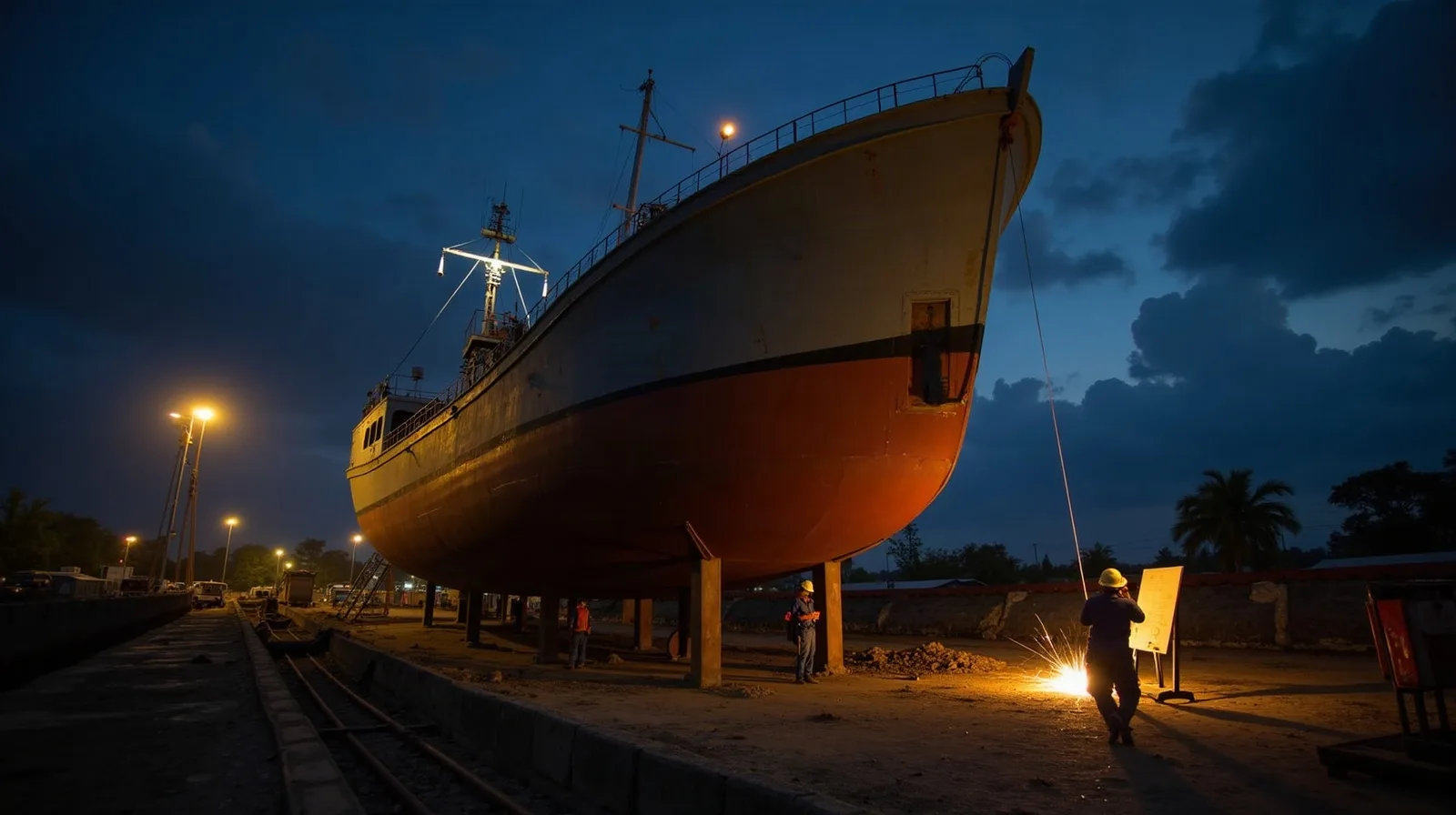
How Many Days in Dry Dock Is Reasonable? Here’s the Math
How many days in dry dock is reasonable? Routine maintenance on a small-to-medium vessel (washing, scraping, spot caulking, antifouling, anodes) should take 5–10 days; a docking with medium work (plank…
-
Boat Building Cost in Indonesia vs Vietnam vs Turkey: A Buyer’s Reality Check
Judging boat building cost — Indonesia vs Vietnam vs Turkey — by headline price is the fastest way to reach the wrong conclusion. Total delivered cost is determined by factors…
-
Liveaboard Vessel ROI: An Honest Way to Calculate Charter Vessel Returns
Charter vessel investments are often judged with models that are too optimistic on revenue and too light on costs. This article sets out a more honest framework for calculating liveaboard…