
Is an Abandoned Wooden Hull Still Worth Completing After 3 Years?
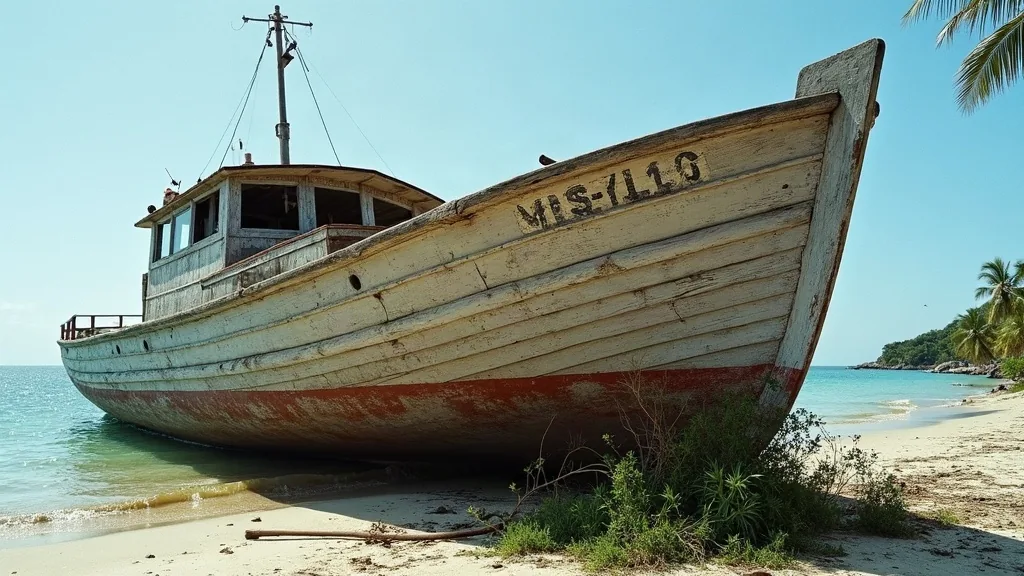
An abandoned wooden hull that has sat unfinished for years does not automatically have to be scrapped, nor is it automatically worth completing. The assessment depends on three structural elements and on one factor that is often overlooked: whether the hull had a roof over it while work was stopped.
What really causes damage, and what only looks bad
A wooden hull left untouched for a long time almost always looks worrying: timber faded to silver-gray, moss on the surface, long hairline cracks in the planking. Most of that is superficial. The damage that really decides the outcome is often invisible from the outside.
The biggest cause of damage is trapped fresh water. Rainwater pooling in joints, in the bottom of a hull with no drainage outlet, or in enclosed spaces without ventilation creates ideal conditions for rot. Seawater, which many people fear, is far less of a problem. That is why the first question we ask before even seeing the vessel is: was this hull protected from rain while work was stopped?
The three elements that decide
Keel
The most expensive structural element and the hardest to replace. Keel damage almost always tips the decision to not worth continuing, because replacing the keel means dismantling most of the hull that stands on it.
Frames
The framework that determines the hull’s shape and strength. A few damaged frames can be replaced at a reasonable cost; damage spread across many frames, especially toward the bow and stern, turns the job into a rebuild at full cost.
Fastenings and joints
Treenails, bolts and metal fastenings that have sat in wet conditions for a long time can corrode from the inside with no sign on the surface. A common finding is a bolt that looks intact at the head but has wasted away along its shank. The only way to check is to draw sample fastenings at selected points.
Tests that must be carried out
| Test | Purpose | Warning sign |
|---|---|---|
| Probe test | Find soft timber | The tool goes in too easily |
| Exploratory opening-up | See the condition behind the planking | Brittle fibers, unnaturally dark color |
| Drawing sample fastenings | Assess hidden corrosion | Wasted shank, enlarged hole |
| Shipworm inspection | Find biological attack | Fine holes in the submerged sections |
| Shape measurement | Assess changes in geometry | The hull is no longer symmetrical |
The last test is often forgotten, yet it matters. A hull that has stood for years on uneven keel blocks can deform permanently, and correcting its geometry is far harder than replacing planks.
A decision framework
The right question is not “can it still be saved?” — technically, almost any hull can. The question is whether saving it costs less than rebuilding. If the damage is limited to the hull planking and some of the frames, completion is generally far cheaper. If it reaches the keel or spreads across most of the frames, the figure quickly matches a newbuild, and the end result is still a hull with a long history ashore.
How to build that comparison is covered in our article the cost to complete a stalled vessel, while the technical treatment of wooden hulls is explained on our phinisi and wooden vessels page.
Four questions before calling a surveyor
Before spending money on an inspection, owners can narrow down the possibilities with four questions whose answers they usually already know.
Did the hull stand under a roof while work was stopped? This is the strongest predictor. Did it stand on even, well-maintained keel blocks, or on blocking that has partly subsided? Uneven blocking over several years produces permanent deformation. Was the timber dry enough when it was fitted, or was it worked in a hurry from green wood? Is water pooling inside the hull with no way out?
If the answers to all four are bad, an inspection will most likely confirm structural damage, and the owner can go straight to considering other options. If the answers are good, the chance that the hull is still sound is fairly high and an inspection becomes a clear investment.
The cost of delaying the decision
What sets a wooden hull apart from a steel hull is how fast the damage progresses. Abandoned steel thins slowly and relatively predictably. Abandoned timber in damp conditions can go from good to unfit within a few seasons, especially in the parts that cannot be seen.
That is why delaying the decision on a wooden hull is not a neutral stance; it is a decision to let the asset lose value. If the owner is not ready to resume construction, the cheapest step that still makes sense is to stabilize the condition: fit a roof, open the drainage, provide ventilation and correct the keel blocks. This costs far less than structural recovery and keeps the options open until the owner is ready. The technical treatment of wooden hulls is set out on our phinisi and wooden vessels page.
Storing a hull that will not be worked on yet
Many owners are not ready to continue but not ready to let go either. In that situation, proper storage is a small expense that preserves the asset’s value significantly.
Four things matter most: a roof or cover that genuinely keeps the rain out, including at the ends, which are often missed; drainage paths inside the hull so that no water is trapped; airflow through every enclosed space, because still air is far more damaging than damp air that moves; and keel blocks that are level and checked regularly so the hull keeps its shape.
A hull stored under these four conditions can wait for years without losing its viability, while a hull left exposed often becomes unfit in a much shorter time.
If the decision is to continue
The first priority is not to resume construction but to stop the damage: fit a temporary roof, open the drainage and ventilate enclosed spaces. Only once the hull is stable does recovery work begin, from the structure outward — frames, joints, planking, kalafat (traditional caulking) — with the coatings applied last, after the moisture content has dropped. Painting a hull that is still saturated is a classic mistake that wastes the entire coating job.
For a full assessment, see condition survey and valuation, or the takeover process on our stalled vessel completion page.
Frequently Asked Questions
Which parts matter most in deciding whether an old wooden hull is viable?
The keel, the frames and the fastenings. Hull planking is relatively easy to replace, whereas damage to the keel and frames affects the primary structure, and its cost quickly exceeds the value of the hull itself.
Do moss and faded timber mean the wood is rotten?
Not necessarily. Faded, mossy timber is often only a surface layer. What decides it is the result of the probe test and the exploratory opening-up, not how the surface looks.
Is a hull stored under a roof really much better off?
Much better. Rainwater pooling in joints and enclosed spaces is the fastest cause of rot, so roofed hulls often remain sound after years of standing idle.
Further reading
-
Buying a Half-Finished Phinisi Hull: A Due Diligence Checklist
A half-finished phinisi hull can be an excellent purchase or an expensive trap, and the difference is almost never visible in photographs. This checklist covers what to verify before money…
-
What To Do When Your Indonesian Boat Builder Goes Bankrupt
When an Indonesian boat builder goes bankrupt or a yard simply stops work, the foreign owner faces two separate problems at once: protecting a physical asset thousands of kilometers away,…
-
What Is the Cost to Complete a Stalled Vessel? An Honest Estimating Framework
There is no standard rate for the cost to complete a stalled vessel, and anyone who quotes one before a survey is guessing. What can be standardized is the framework:…