
Propeller Shaft Vibration: Reading the Symptoms
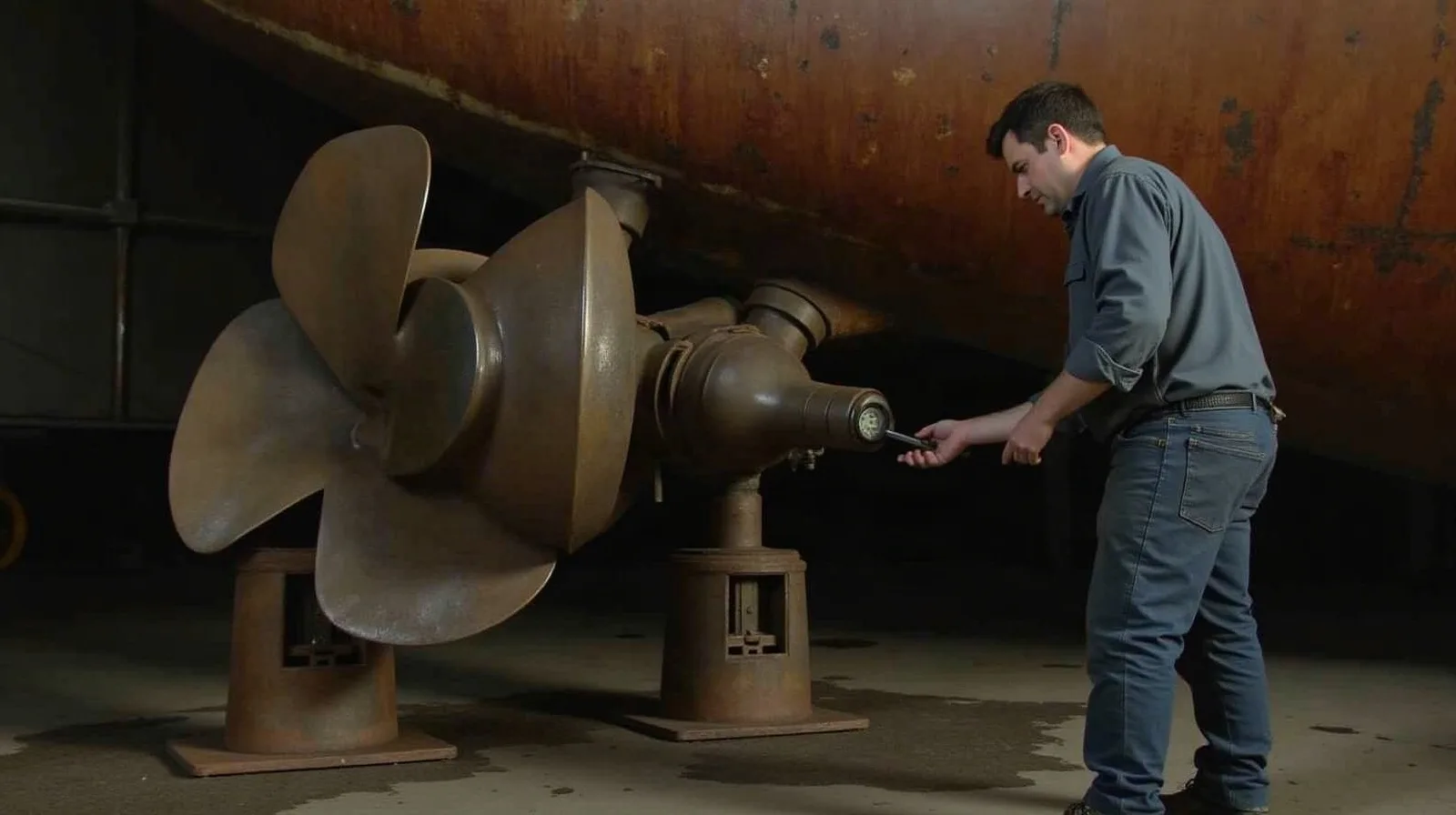
Vibration that appears or changes character is a vessel’s cheapest early warning, almost always sounding before major damage. To separate engine from propeller shaft vibration: if it changes with engine RPM, check the engine and clutch; if it changes with vessel speed and propeller load, check the propeller, shaft and bearings. Reading this right can save thousands of dollars.
Kendari Shipyard Desk put this diagnostic guide together from the cases we meet most often on fishing vessels, workboats and tourism vessels in Southeast Sulawesi. The distinction matters because it decides whether the vessel can be dealt with afloat or has to be dry-docked.
Quick map: symptom → likely cause
| Symptom | Most likely cause | First action |
|---|---|---|
| Rough vibration at all RPM, worse when you throttle up | Damaged propeller: bent, chipped, or fouled and tangled | Visually check the propeller; quick dive check if safe |
| Vibration only in a certain RPM range | Shaft resonance / engine mounts starting to weaken | Check mount bolts and engine–shaft alignment |
| Vibration plus a rhythmic knocking from the stern | Worn shaft bearing (cutless bearing) | Rock the shaft with the vessel at rest; measure the clearance |
| Vibration plus excessive water through the packing | Worn stern tube / stuffing box or propeller shaft | Tighten the packing; schedule a dock inspection |
| Constant fine vibration, slowly increasing over months | Propeller fouling or even wear | Clean the propeller; watch the trend |
| Sudden vibration after hitting something | Bent propeller blade / twisted shaft | Reduce RPM, proceed slowly, inspect as soon as possible |
Step-by-step diagnosis the crew can do
Step 1: note when the vibration appears
Three key questions: at what RPM is the vibration felt? Does it change with the clutch in neutral (vessel stationary, engine running)? Does it get worse when the vessel is loaded? Vibration that persists with the clutch in neutral means the source is the engine or clutch — not the propeller. This is the single most useful first filter.
Step 2: a simple visual inspection
With the vessel alongside: check the engine mount bolts (look for fresh rust marks or cracked paint around the bolts — a sign of movement), check the alignment of the coupling to the shaft, and feel the shaft packing. If the water is safe, a dive check can confirm whether rope, net or plastic is wrapped around the propeller — the most common and cheapest cause of sudden vibration.
Step 3: the shaft rock test
With the engine off, rock the shaft up and down near the stern bearing. Clearly noticeable play means a worn bearing. A bearing left loose will eat into the shaft — damage far more expensive than the bearing itself.
When afloat is enough, and when the vessel must be dry-docked
Can be handled without hauling out: clearing a fouled propeller, tightening engine mounts, coupling alignment and replacing packing. Dry docking required: straightening or replacing propeller blades, replacing shaft bearings, drawing the shaft to measure its straightness, and stern tube repair. The detailed scope of this underwater work is on our propeller & shaft repair in Kendari page.
Don’t diagnose vibration apart from engine condition
Vibration is often a combined symptom: an engine past its overhaul hours vibrates more roughly, and that vibration speeds up wear on the shaft and mounts. If your engine’s running hours are already high, read our article top overhaul vs major overhaul to decide the engine work at the same time as the shaft repair — combining both in one dry docking is much cheaper than hauling out twice. We cover the full engine inspection itself on our marine engine overhaul in Kendari page.
The cost of leaving it vs the cost of fixing it
From the pattern of cases we supervise, the escalation is almost always the same: fouled propeller (cleaned — small cost) → worn bearing (replaced — medium cost) → shaft eaten away and needing to be machined or replaced (large cost) → stern tube damaged and the stern structure affected too (very large cost plus a long time out of service). Every stage passed without action multiplies the cost of the next. A small vibration today is a small job; the same vibration six months from now may not be.
If your vessel shows any of the symptoms in the table above, send a description of the symptoms plus a short video to our desk — from there we can help sort out whether you need a diver, an afloat technician or a dock slot, complete with a USD estimate for each scenario.
Recording vibration: simple data that changes the diagnosis
The crew doesn’t need expensive instruments to start collecting data. Three simple habits help technicians a great deal: first, note the RPM when the vibration starts to be felt and when it is worst — these numbers separate resonance (appearing in a narrow range) from progressive damage (the higher the RPM, the worse it gets). Second, record a short video with sound from the same position every time (for example above the stern tube) — comparing week to week shows a trend the everyday ear does not notice. Third, note the triggering event: after passing over something in the water, after the last dry docking, after a propeller change. Vibration that appears right after dry docking, for example, often points to the propeller fitting or a change in alignment — information that cuts the search time in half.
A cost-efficient inspection sequence
The principle: check the cheap things first. The order we use: (1) visual check and propeller fouling — free to cheap; (2) tightness of engine mounts and coupling — cheap, can be done afloat; (3) shaft rock test and packing check — cheap, afloat; (4) full dive inspection — small cost; (5) only when all of the above is clear, plan a haul-out for bearing inspection, shaft withdrawal and straightness measurement. Jumping straight to a haul-out without steps 1–4 means paying for a haul-out for a problem that may be just a length of rope on the propeller. Conversely, stopping at the light steps when the symptoms point to the bearing means buying shaft damage. Good diagnosis is not the most sophisticated — it is the one with the most disciplined sequence.
One closing habit we pass on to every crew we work with: know your own vessel’s normal vibration. Every vessel has its vibration signature — a unique combination of engine, shaft, propeller and hull. A crew that knows every day what a healthy vessel feels like will catch a deviation weeks earlier than any instrument fitted only once the problem is already big. Vibration is the vessel’s language; this article is the dictionary, and a trained crew’s ear is its best interpreter. If in doubt, send a video and a description of the symptoms — an initial diagnosis from our desk is free of charge.
FAQ
How do you tell engine vibration from propeller vibration?
Test with the vessel stationary and the clutch in neutral: if the vibration remains, the source is the engine or clutch; if it disappears and only appears when the vessel is under way, the source is the propeller, shaft or bearings.
Can vibration be fixed without dry docking?
Some of it can: clearing rope wrapped around the propeller, tightening engine mounts, coupling alignment and replacing packing. Straightening the propeller, replacing shaft bearings and drawing the shaft require the vessel to be dry-docked.
What is the risk of leaving mild vibration for months?
The escalation is a chain: a worn bearing eats into the shaft, a worn shaft damages the stern tube, and the stern structure is affected too. Every stage left alone multiplies the cost of the next.
Compiled by Kendari Shipyard Desk — specialist maritime brand under Juara Holding Group. Service contracts through PT Komodo Galangan Nusantara. Slot and estimate inquiries: WhatsApp 6281139414563 or bd@juaraholding.com.
Further reading
-
Fiberglass Hull Osmosis in the Tropics: Blisters and Gelcoat
Fiberglass hull osmosis — water slowly soaking into the laminate and raising blisters — is one of three tropical enemies of a fiberglass boat, together with sun-degraded gelcoat and careless…
-
Galvanic Corrosion on Vessels: Early Detection and Anodes
Galvanic corrosion on vessels occurs when two dissimilar metals are electrically connected in seawater: the more active metal corrodes to protect the more noble one. Steel hull plate, shafts and…
-
Top Overhaul vs Major Overhaul: Decide by Running Hours
The top overhaul vs major overhaul decision is safest made from engine running hours, not gut feeling. Rule of thumb for mid-size marine diesels: top overhaul (cylinder heads, valves, injectors)…