
Top Overhaul vs Major Overhaul: Decide by Running Hours
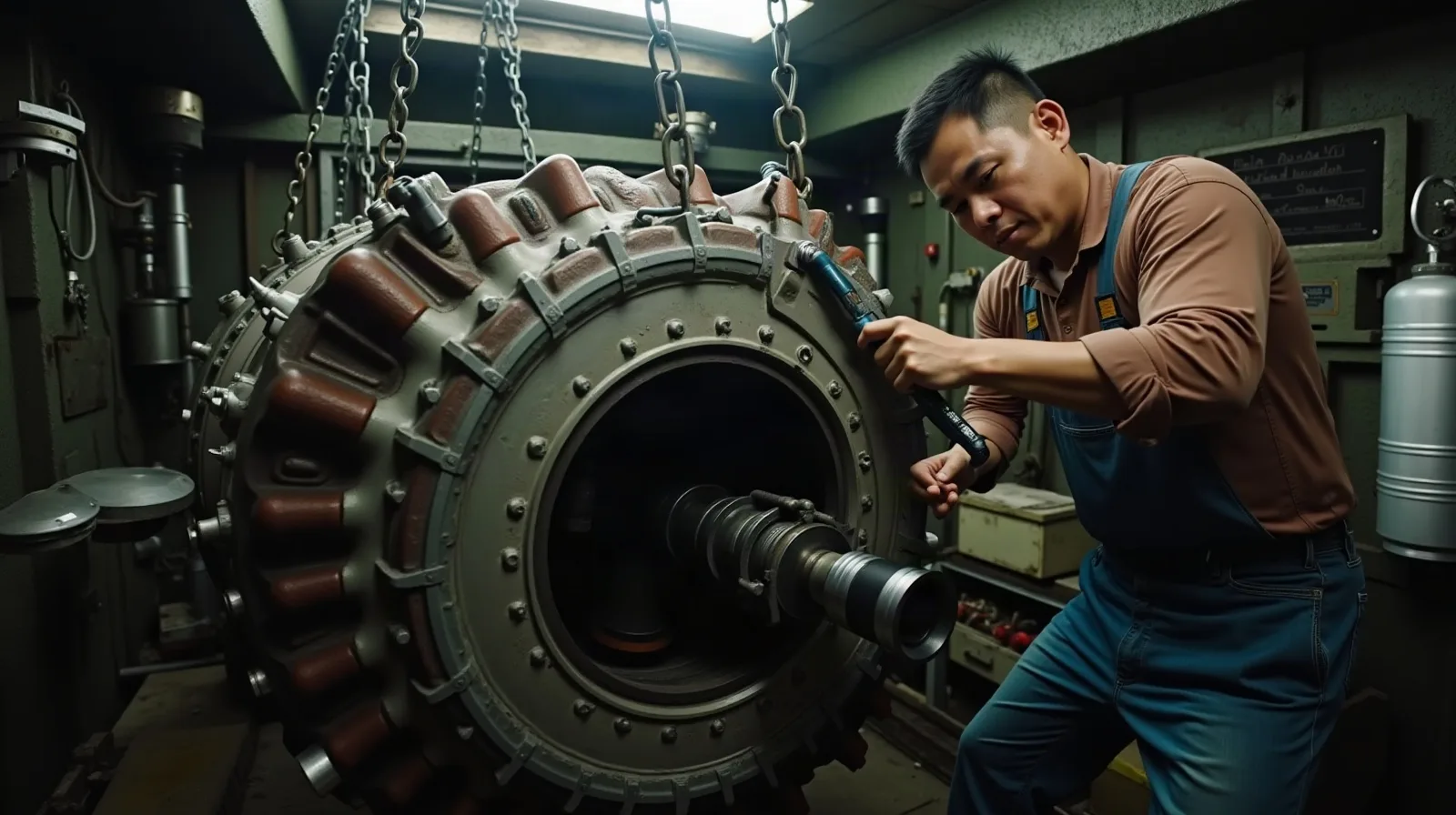
The top overhaul vs major overhaul decision is safest made from engine running hours, not gut feeling. Rule of thumb for mid-size marine diesels: top overhaul (cylinder heads, valves, injectors) at 4,000–8,000 hours; major overhaul (full teardown: pistons, liners, crankshaft bearings) at 12,000–20,000 hours, per each manufacturer’s manual. Engines left past these thresholds head toward failures costing several times more.
Kendari Shipyard Desk wrote this guide because the same pattern keeps repeating in the field: overhauls are postponed “because the engine still runs,” until the engine decides for itself when to stop — usually at the worst possible time and place.
What the difference really is
Top overhaul
Work on the upper part of the engine without opening up the block: the cylinder heads come off, valves and seats are lapped or replaced, injectors are calibrated, and the coolers and turbocharger are inspected. The vessel usually only needs to stop for a few days, and the work can be done afloat at the berth.
Major overhaul
A complete teardown: pistons and rings come out, liners are measured or replaced, main and connecting-rod bearings are replaced, the crankshaft is measured for straightness, and the pumps are reconditioned. It takes weeks, workspace, lifting gear and experienced mechanics — and it is most efficient when done together with dry docking, so the vessel’s downtime is not doubled.
A decision tree based on running hours
| Condition | Decision |
|---|---|
| Running hours below the top-overhaul threshold, normal performance | Routine maintenance only; record the trend |
| Approaching or past the top-overhaul threshold | Schedule a top overhaul in the nearest quiet window |
| Already 1–2× top overhauls and approaching the major threshold | Plan a major overhaul; combine it with dry docking |
| Serious symptoms below the threshold (falling oil pressure, blue smoke, heavy blow-by, metal in the filter) | A major overhaul does not wait for the hours — inspect immediately |
| Old engine + major overhaul cost approaching the price of a new engine | Compare overhaul vs repowering |
If running hours have not been recorded — common on vessels that have changed owners — start with a condition check: compression pressure on each cylinder, oil pressure, oil analysis if available, and blow-by. The results place your engine in one of the rows of the table above.
Symptoms that show which overhaul you need
Pointing to a top overhaul: the engine is hard to start but runs normally once warm, white smoke when cold, rising fuel consumption, rough valve noise. Pointing to a major overhaul: persistent blue smoke (burning oil), oil pressure dropping at low rpm when the engine is hot, heavy blow-by from the breather, and rough vibration that does not go away after the injectors are calibrated. Note: vibration can also come from the shaft and propeller — rule that out first with our guide to reading propeller and shaft vibration symptoms before blaming the engine.
Common mistakes that make an overhaul fail
First, the half overhaul: pistons replaced but the old liners kept “to save money,” or bearings replaced without measuring the crankshaft. New components paired with worn ones wear down to match their partners — and the life of the overhaul is cut in half. Second, parts of unknown origin: imitation parts without specifications on critical components. Third, no measurements: a proper overhaul is micrometer work — every clearance is recorded and compared against the manufacturer’s limits; without a measurement sheet, you do not know what you have actually paid for. Fourth, skipping the running-in: the engine is pushed straight to full load after the overhaul.
Combining the overhaul with your dry-dock schedule
A major overhaul is cheapest when it is piggybacked on a dry docking that is mandatory anyway — one stoppage for two big jobs. Our supervision covers oversight of the measurement sheets, spare-part verification and staged trials; service details are on our marine engine overhaul in Kendari page. To work out how long a vessel should reasonably stop for a combination of jobs like this, the cost bands are in our Kendari dry docking cost guide — all in USD per item.
A closing principle: a scheduled overhaul is a cost; an overhaul forced by a breakdown is a cost plus a vessel out of service plus your reputation with charterers. Your engine’s running hours today already tell you which of the two you will face.
Overhaul vs repowering: when the engine is better replaced
There comes a point where the right question is no longer “top or major” but “overhaul or replace the engine.” Consider repowering when the cost of a major overhaul approaches or exceeds the price of a replacement engine, spare parts for the old engine are becoming harder to find and more expensive, its fuel consumption is far above that of new-generation engines, or the engine block itself has already cracked and been repaired. Conversely, an engine with a clear history, readily available parts and a sound block is almost always more economical to overhaul properly. The calculation must include the knock-on work of repowering that is often underestimated: new engine foundations, shaft and propeller adjustments, cooling and exhaust systems, plus electrical work — items that can add up to the price of the engine itself.
Choosing the contractor and controlling quality
The same overhaul on paper can produce an engine that lasts three years or eight years — the difference is the contractor and the supervision. What we check before appointing a workshop: experience with the same make and model of engine, ownership of measuring tools (inside and outside micrometers, Plastigauge, calibrated torque wrenches), access to genuine or OEM-equivalent parts with certificates, and willingness to work with signed measurement sheets. During the work, our supervision photographs every component before and after, verifies every clearance against the manual, and holds back payment milestones until staged load testing is passed. This approach is not bureaucracy — it is the only way to make sure your overhaul money actually buys engine running hours, not just an engine that starts at the berth.
To close, one habit makes every one of these decisions easy: log the engine’s running hours every day, without exception. An honest running-hours log is a financial document — it tells you when big money needs to be ready, long before the engine forces the issue. Owners who hold running-hours data negotiate with workshops from a position of strength, budget overhauls in USD without surprises, and almost never suffer an engine breakdown at sea. Owners who don’t keep records are saving up for a surprise — and surprises in the engine room are never cheap. Start logging today; your engine has been counting for a long time.
FAQ
At how many running hours does a marine engine need a top overhaul?
The common pattern for mid-size marine diesel engines is a top overhaul at around 4,000–8,000 hours and a major overhaul at 12,000–20,000 hours, with the exact figures following each engine manufacturer’s manual.
What symptoms show an engine needs a major overhaul, not just a top overhaul?
Persistent blue smoke, oil pressure dropping at low rpm when the engine is hot, heavy blow-by from the breather, and metal particles in the oil filter. These symptoms point to wear of the pistons, liners and bearings in the lower end of the engine.
Why should an overhaul be combined with the dry-docking schedule?
A major overhaul requires the vessel to stop for weeks; piggybacking it on a dry docking that is mandatory anyway means one stoppage covers two big jobs, cutting the total number of days the vessel is not earning.
Prepared by Kendari Shipyard Desk — specialist maritime brand under Juara Holding Group. Service contracts through PT Komodo Galangan Nusantara. Slot and estimate inquiries: WhatsApp 6281139414563 or bd@juaraholding.com.
Further reading
-
Fiberglass Hull Osmosis in the Tropics: Blisters and Gelcoat
Fiberglass hull osmosis — water slowly soaking into the laminate and raising blisters — is one of three tropical enemies of a fiberglass boat, together with sun-degraded gelcoat and careless…
-
Galvanic Corrosion on Vessels: Early Detection and Anodes
Galvanic corrosion on vessels occurs when two dissimilar metals are electrically connected in seawater: the more active metal corrodes to protect the more noble one. Steel hull plate, shafts and…
-
Realistic Antifouling Interval for the Banda Sea
In the warm waters of eastern Indonesia, including the Banda Sea and around Wakatobi, antifouling works harder than almost anywhere else: year-round warmth makes barnacles, algae and shipworm grow fast,…