
How Many Days in Dry Dock Is Reasonable? Here’s the Math
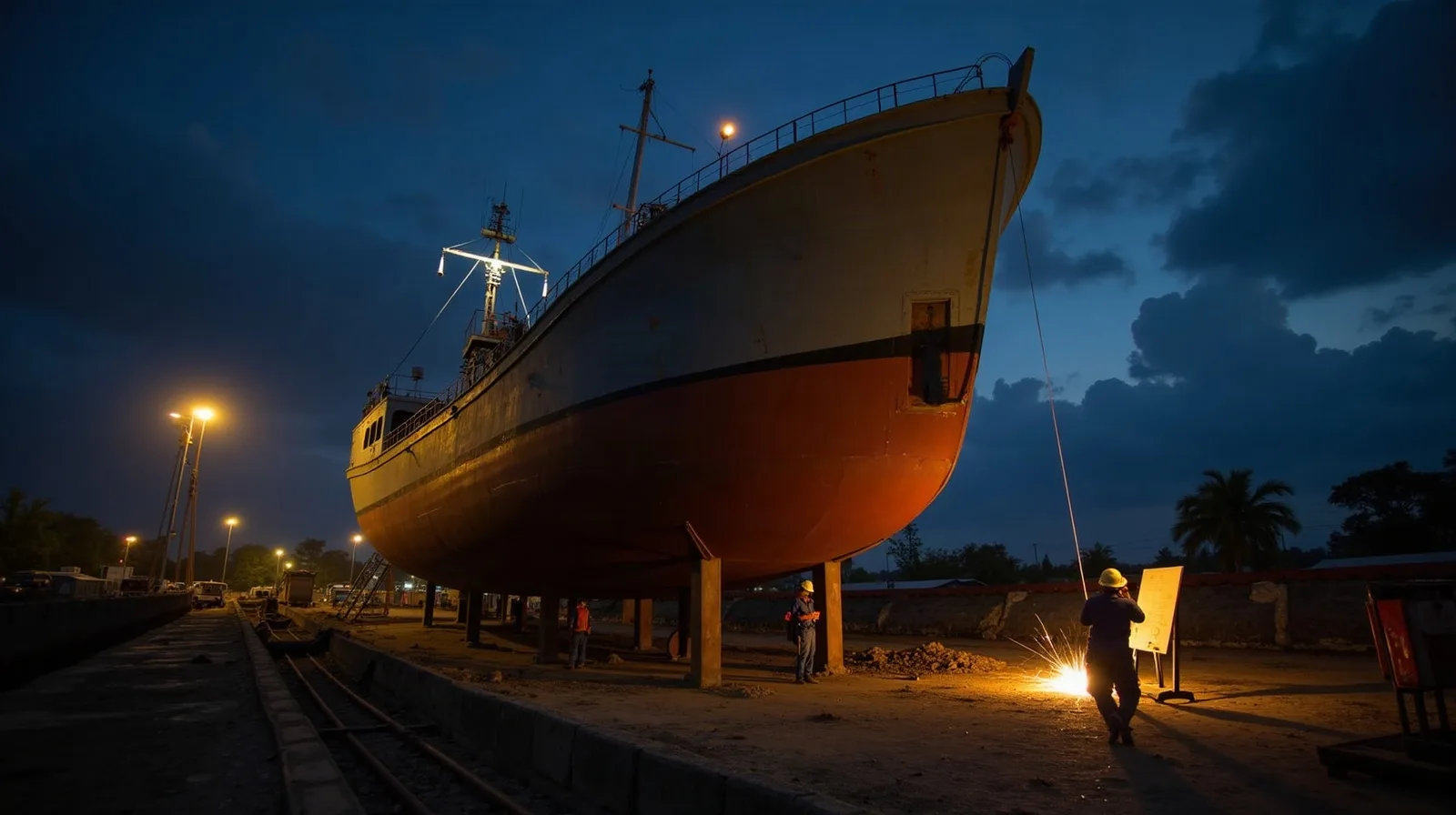
How many days in dry dock is reasonable? Routine maintenance on a small-to-medium vessel (washing, scraping, spot caulking, antifouling, anodes) should take 5–10 days; a docking with medium work (plank inserts, shaft repair, top overhaul) 2–4 weeks; and major work (replating, extensive plank replacement, major overhaul) 4–8 weeks or more.
Every day beyond a reasonable count is a double cost: the dock-day rate keeps running, and the vessel earns nothing. This article shows you how to calculate it yourself — so you know when a shipyard’s timeline makes sense and when it is slipping. Kendari Shipyard Desk wrote this guide from data on the jobs we supervise at facilities in Kendari and Southeast Sulawesi. The main role of our supervision really comes down to one thing: stopping dock days from leaking away.
The basic dry docking duration formula
A reasonable dock duration = fixed days + scope days + findings buffer.
Fixed days (almost every vessel): haul-out + positioning + washing and scraping (1–2 days), drying before painting and the refloating process (1–2 days). Scope days: calculated per work item from the table below. Findings buffer: 10–20% of the scope days for things that only become visible once the hull is clean — older vessels or vessels that have not been docked for a long time should use the upper figure.
Duration table by type of work
| Work | Reasonable duration | Typical causes of overrun |
|---|---|---|
| Washing, scraping, inspection | 1–2 days | Heavy fouling, limited working water |
| Full antifouling (primer + 2–3 coats) | 3–5 days | Rain; each coat needs to dry |
| Complete recaulking (wooden vessels) | 5–10 days | Number of caulkers who actually show up |
| Plank inserts/replacement (per 5–10 planks) | 7–14 days | Availability of seasoned timber in the right sizes |
| Limited steel replating | 1–3 weeks | Plate procurement, certified welders |
| Shaft withdrawal + bearing replacement | 1–2 weeks | Shaft turning if worn; parts from out of town |
| Engine top overhaul | 1–2 weeks | Spare parts; can run in parallel with hull work |
| Major overhaul | 3–6 weeks | Measurements & precision parts; do not rush it |
The key to reading the table: work that can run in parallel is not added up — a well-managed docking works on the hull, engine and shaft at the same time with different teams. A badly managed docking does them one after another, and that is where the weeks disappear.
Five preventable causes of overrun
1. Materials not on site when the vessel is hauled out. The number one cause. Large planks, plates, shafts, engine spare parts — every long-lead item must arrive before the vessel is hauled out, not be ordered afterward. 2. Scope not in writing. “While we’re at it, this too, and that too” on the dock is a machine for adding days. 3. Findings without quick decisions. An owner who is slow to decide on additional work pays dock days while thinking it over. Set a value threshold: below amount X, the supervisor may decide on the spot. 4. Labor shared with other vessels. In the busy season, workers get pulled in every direction — without daily supervision, your vessel is the one that loses out. 5. Weather for paintwork. Schedule painting in a dry window; one day of rain can push things back by three days.
Almost all of the prevention above happens before the vessel is hauled out — that is the subject of our article the 40-point pre-docking inspection checklist.
Calculating the cost of dock days vs the cost of an idle vessel
Total duration cost = (dock-day rate × days) + (the vessel’s daily operating value × days). For an active commercial vessel, the second component is almost always larger — which means paying for a bigger team to finish sooner is often cheaper overall. The same calculation also decides where to dock: a nearby facility with a slightly higher rate usually wins against a distant “cheap” one — the full comparison is in our article dry docking in Kendari vs sailing to Makassar.
What a healthy dock schedule looks like
Before the vessel is hauled out, you should be holding: a schedule per item with start and finish dates, a materials list with procurement status, and the name of the person responsible for each job. While the docking is underway: daily photo reports and a simple progress curve. That is our standard supervision format — the process is on our how it works page, and the dock-day rate bands plus per-item service rates in USD are in the Kendari dry docking cost guide.
A vessel that is hauled out with a planned refloating date and is refloated on that date — that is not luck, it is management. And because every dock day is money, that management pays for itself from the first week.
A full worked example: a 30 GT purse seiner
Let’s calculate one complete case. A 30 GT wooden fishing vessel is hauled out with this scope: washing and scraping, spot caulking of 20% of the seams, replacing four planks, full antifouling, anode replacement and servicing the shaft packing. Fixed days: haul-out + positioning + washing = 2 days; drying and refloating = 2 days. Scope days: plank replacement (the longest job, running in parallel with the caulking) = 6 days; antifouling afterward = 3 days. The other items fit in between. Subtotal = 13 days; findings buffer of 15% ≈ 2 days. Reasonable total: 15 days. If a shipyard quotes 25 days for this scope, something needs to be questioned — usually the number of workers or the yard’s internal queue. If it quotes 8 days, question that too: which stage will be sacrificed — almost always the drying time for the paint. Both hurt you, in different ways.
Schedule clauses in the work agreement
A calculated duration should be locked into a written agreement: the haul-out date and target refloating date, a schedule per work group, consequences for delays caused by the shipyard (for example, waiving the dock-day rate after the target date), and an approval mechanism for additional work — whatever its value, in writing, with its schedule impact stated. An agreement like this is not a sign of distrust; it actually keeps the relationship with the shipyard healthy, because both sides’ expectations are measurable from the start. A good shipyard does not object to schedule clauses — those that do are usually selling the same slot to too many vessels. In every supervision assignment, making sure these clauses exist and are enforced is part of our job — because a reasonable number of dock days only happens on vessels that plan for it.
FAQ
How long does a normal docking for routine maintenance take?
A small-to-medium vessel with a scope of washing, scraping, spot caulking, antifouling and anodes should be finished in 5-10 days. Medium work takes 2-4 weeks, and major work such as replating or a major overhaul 4-8 weeks or more.
What most often causes a docking to overrun?
Materials that have not arrived when the vessel is hauled out. Large planks, plates, shafts and engine spare parts are long-lead items that must be ordered before the vessel is hauled out, not after findings on the dock.
How do you calculate the real cost of dock duration?
Add the dock-day rate to the vessel’s lost daily operating value. For an active commercial vessel the second component is usually larger, so speeding up the work with a bigger team is often cheaper overall.
Prepared by Kendari Shipyard Desk — a specialist maritime brand under Juara Holding Group. Service contracts through PT Komodo Galangan Nusantara. Slot and estimate consultations: WhatsApp 6281139414563 or bd@juaraholding.com.
Further reading
-

Dry Docking Kendari vs Makassar: Running the Numbers
For vessels working Southeast Sulawesi, Wakatobi or the Banda Sea, the dry docking Kendari vs Makassar comparison almost always favors Kendari on total cost, provided vessel size and scope fit…
-
Boat Building Cost in Indonesia vs Vietnam vs Turkey: A Buyer’s Reality Check
Judging boat building cost — Indonesia vs Vietnam vs Turkey — by headline price is the fastest way to reach the wrong conclusion. Total delivered cost is determined by factors…
-

Liveaboard Vessel ROI: An Honest Way to Calculate Charter Vessel Returns
Charter vessel investments are often judged with models that are too optimistic on revenue and too light on costs. This article sets out a more honest framework for calculating liveaboard…