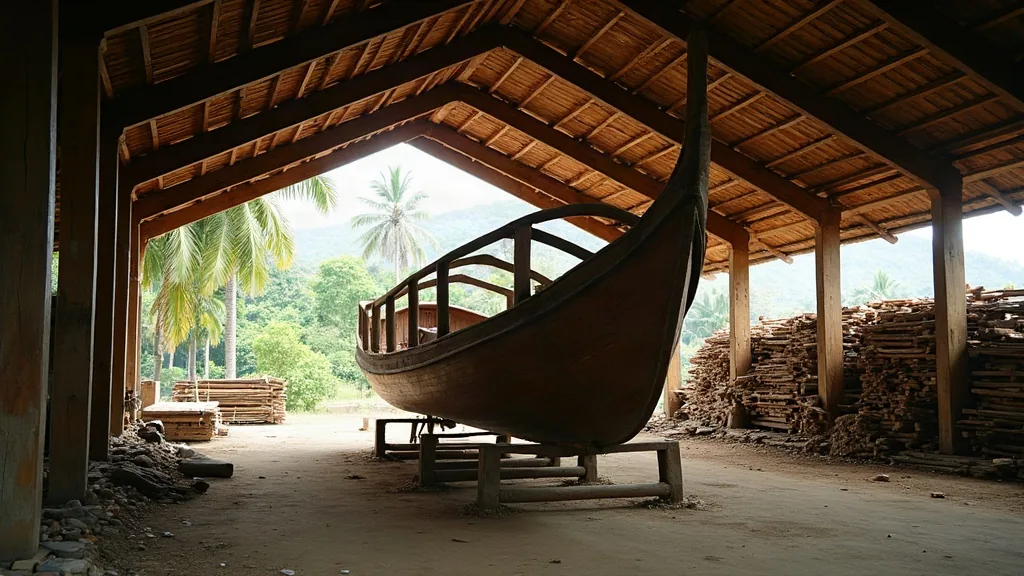
An unfinished phinisi hull can be an excellent purchase or an expensive trap, and the difference is almost never visible in photographs. This checklist covers what to verify before money moves, in the order that saves the most cost.
1. Structure before everything else
Start at the keel. It is the most expensive component to replace and the one whose failure ends the discussion, because replacing it means dismantling most of what stands on top. Then move to the frames, particularly at bow and stern where curvature is sharpest and where standing water tends to collect. Planking matters less than buyers expect; individual planks are replaceable at reasonable cost.
Surface appearance is a poor guide. Silvered, moss-marked timber is frequently sound underneath, while smooth painted planking can conceal soft wood. Only exploratory opening at selected points and probe testing give a reliable answer. The detailed assessment method is set out in is a long-abandoned timber hull still worth finishing.
2. Ask how the hull was stored
One question predicts condition better than any other: was the hull under a roof? Trapped fresh water — rain sitting in joints, in enclosed compartments, in a bilge with no drainage — is the dominant cause of rot in Indonesian timber hulls. Salt water is far less destructive. A hull that stood five years under shelter is often healthier than one that stood two years exposed.
Also check how it was blocked. A hull supported unevenly for years can deform permanently, and correcting geometry is harder and costlier than replacing timber.
3. Verify who owns what
The hull and the materials around it are often owned by different parties, particularly where a previous buyer paid for engines or equipment that were never installed. Establish in writing what is included in the sale, and confirm that the seller can actually transfer it. Loose machinery, shafting and fittings stacked beside a hull are the most commonly disputed items in these transactions.
4. Establish the drawing and certification position
Many traditional hulls are built from inherited practice rather than an approved drawing set. That is a legitimate building tradition, but it creates a specific problem for any owner who intends to class, certify and operate the vessel commercially: without approved drawings, structure that is already enclosed cannot be verified from outside.
Before buying, determine whether drawings exist, whether any surveyor witnessed construction, and what verification route would be required. This frequently changes the economics of the purchase more than the physical condition does. The Indonesian documentation sequence is explained at BKI class and Indonesian ship certification, and the specific question of certifying an unfinished hull at can an unfinished hull still be classed.
5. Price the completion, not the hull
| Cost block | Typically underestimated? | Why |
|---|---|---|
| Assessment & drawings | Yes | Invisible work that produces no visible progress |
| Opening & remedial work | Strongly | Only quantifiable after structure is opened |
| Remaining structure | No | Straightforward to measure |
| Systems & interior | Yes | Highest item count of any block |
| Documentation | Yes | Separate queues, independent of yard schedule |
A hull that looks seventy per cent complete can cost more than the remaining thirty per cent suggests, because part of that seventy may need removing first. The full framework is at how much does completing a stalled build actually cost.
6. Set the walk-away number before you look
Decide in advance what completed value you are targeting, and what total outlay makes the project sensible. Compare against two benchmarks: the cost of a fresh new build, and the price of finished vessels of similar type on the market. Buyers who skip this step tend to keep spending because the hull is already theirs, which is the most expensive reason in this business.
Questions to put to the seller in writing
Verbal answers evaporate; written ones become part of the record. Seven questions worth asking in writing before committing.
Who built the hull, and is that builder still operating? Why did construction stop, and when exactly? Has the hull been under a roof since work stopped? What timber species were used for keel, frames and planking, and what was their moisture condition at installation? Were any drawings produced, and were they approved by anyone? Which items on site are included in the sale, and can ownership be evidenced? And is there any outstanding claim, unpaid invoice or third-party interest attached to the hull?
The last question is the one sellers most often answer vaguely, and the one that most often derails a completed purchase months later.
Structuring the offer around what you cannot see
The defining feature of an unfinished hull is that a portion of the work is already concealed and cannot be inspected without opening. A sensible offer accounts for that rather than pretending it away.
Two mechanisms work well. The first is a staged purchase: an initial payment secures exclusivity while exploratory opening is carried out at agreed points, with the balance conditional on findings. The second is a price adjustment clause tied to specific measurable thresholds — timber condition at nominated frames, or measured deformation against the design geometry.
Sellers confident in the hull rarely object to either. Sellers who refuse any inspection-linked mechanism are telling you something useful. Once purchased, the completion itself should sit under a separate contract with milestone-linked payments, as set out at cost, payment terms and escrow, and the completion process at penyelesaian kapal mangkrak.
7. Structure the purchase and the completion separately
Buy the hull under one agreement; contract the completion under another, with instalments tied to verified physical milestones. Merging the two invites the same failure that stopped the build originally. Our structure is described at cost, payment terms and escrow, and the completion process itself at stalled vessel completion. All contract values are stated in USD.
Frequently Asked Questions
Is buying an unfinished hull cheaper than commissioning a new build?
Sometimes, but only after completion cost is measured. An unfinished hull carries unknown work quality and unknown material history, so the price gap has to cover both the remaining work and the risk that concealed work must be redone.
What single check matters most?
Keel and frame condition. Planking is comparatively replaceable, but structural damage in the keel or across many frames turns completion into a rebuild at full cost with none of the benefits of starting fresh.
Does an unfinished hull come with usable drawings?
Frequently not. Many traditional hulls are built from established practice rather than a drawing set, which means an as-built drawing package must be reconstructed before the vessel can be classed or certified.