
Vessel Size and Dock Options in Southeast Sulawesi
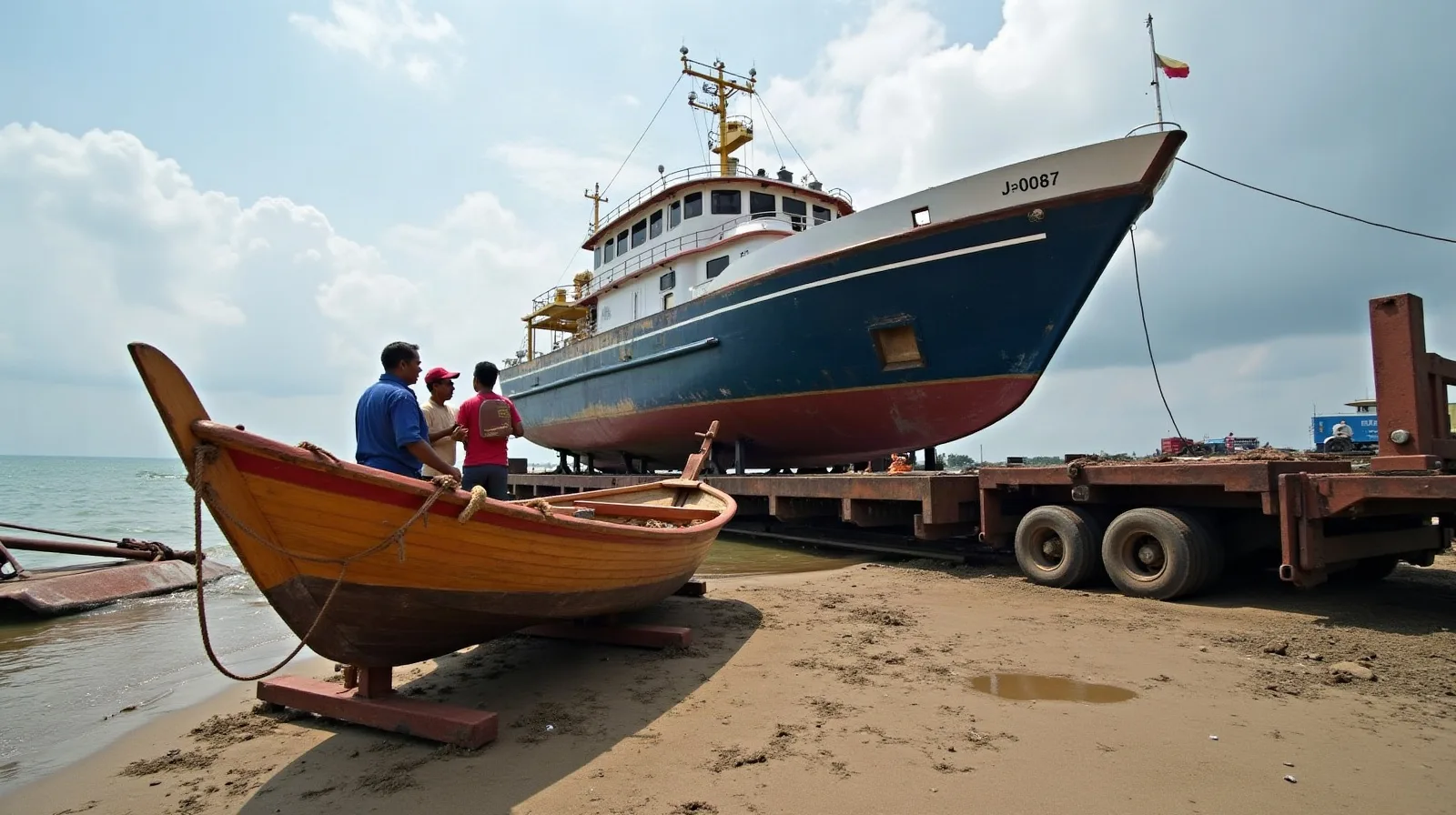
In Southeast Sulawesi, matching vessel size and dock options comes before price: small wooden and fiberglass vessels (below the 30–100 GT range) use Kendari’s coastal slipways; large wooden and light steel vessels (up to the hundreds of GT) suit the Moramo–Lapuko yard cluster; steel vessels above roughly 1,000 DWT must plan for a large dock outside Southeast Sulawesi.
Size and hull construction decide the dock long before price enters the conversation, and placing a vessel at an unsuitable facility is not just a matter of queuing — it is a matter of the vessel’s structural safety during the haul-out and while it sits ashore. Kendari Shipyard Desk compiled this matrix as a planning tool. Its figures are guidance, not official facility specifications — we always re-verify actual capacity against the vessel’s data before booking.
Size × facility matrix
| Vessel class | Examples | Suitable facility | Method |
|---|---|---|---|
| < ±30 GT, wood/fiberglass | Small fishing vessels, speedboats | City slipways, beach haul-out points | Small rail, beach haul-out, airbag |
| ±30–100 GT | Purse seiners, workboats | City slipways / Moramo–Lapuko | Rail slipway, airbag |
| ±100–300 GT wood/light steel | Large wooden vessels, small coasters | Moramo–Lapuko yard cluster (verify per facility) | Rail slipway, large airbags |
| Small-to-medium steel, afloat scope | Tugboats, small LCTs | Kendari wharves — work done afloat | Afloat |
| > ±1,000 DWT steel | Cargo vessels, small tankers, large barges | Large dock on the eastern routes | Graving/floating dock |
Why hull construction also determines the method
Two vessels of the same size can require different handling because their hulls differ. A steel vessel tolerates concentrated loads on the keel blocks well; a wooden vessel stakes everything on how the blocks land under the keel and frames — a block misplaced in the middle of a plank span can crack a structure that is decades old. That is why, for large wooden hulls, distributing the load with airbags during the haul-out is often gentler, followed by careful blocking at the strong points. The same logic works in reverse: understanding how a wooden hull is built is the best way to understand where it may be loaded — a good reference is the wooden hull construction standards used in new phinisi builds, which show exactly why the keel and frames are the only legitimate load path on a wooden vessel. Our full comparison of the two haul-out methods is in the article airbag haul-out vs rail slipway.
GT, DWT, LOA: which language a facility speaks
Three units often get mixed up in booking conversations. GT (gross tonnage) measures volume; DWT measures carrying capacity; LOA is length overall. Small facilities usually think in LOA and actual hauling weight (how many tons the winch and cradle can handle); large docks speak DWT. When requesting a slot, have all three ready plus the draft and the vessel’s lightweight — those five numbers let capacity verification be completed in one conversation, not three.
Borderline cases that need care
Vessels at the top end of a facility’s capacity
The vessel that “still fits, apparently” is the riskiest category. An old winch pulled to its limit, a cradle taking its maximum load, rails that are rarely inspected — this combination has claimed victims in many places. Our rule: if a vessel falls within the top 20% of a facility’s nominal capacity, we ask for evidence of the equipment’s condition or move to another facility.
Barges
Mining-size barges can rarely be hauled out locally; most of their needs are handled afloat (welding afloat, limited plate replacement above the waterline) or wait for a slot at a large dock. The planning differs from crewed vessels and is best discussed case by case.
Tourism vessels of mixed construction
A wooden dive boat with a fiberglass superstructure, or a fiberglass boat with wooden stringers, requires the strong points to be checked before blocking — do not let the shipyard guess.
From matrix to decision
How to use it in practice: find your vessel’s row, verify the facility in its column (this is our job — winch, cradle and airbag condition and queues change from month to month), then draw up the scope and budget. An overall picture of facilities by area is in the Kendari shipyard & docking guide, the technical haul-out process on the slipway & haul-out Kendari page, and USD cost bands per size class in the dry docking cost guide.
The closing principle is simple: the right facility for your vessel is not the largest or the cheapest, but the one whose actual capacity exceeds the vessel’s needs with a safe margin — and the only way to know actual capacity is to verify it. That is the first service we provide, before a single dollar is discussed.
Draft and water access: the dimension that is often forgotten
The size matrix is not complete without one more check: whether the vessel can reach the facility. Slipways and haul-out points in this area are served by approach waters of limited depth that change with the tide — a deep-draft vessel may be within a facility’s hauling capacity yet unable to approach except at high water. That is why haul-out schedules at shore facilities are always planned around the tide calendar, and deep-draft vessels sometimes have to wait for spring tides for the best window. This approach-draft information is among the things we verify directly at each facility — the figure in the brochure and the reality on site are not always the same, especially after the rainy season has shifted the sediment.
Planning fleet growth with this matrix
The size-vs-facility matrix is also a tool for planning vessel purchases. An owner planning to add a larger vessel should first check: where will that vessel be hauled out every year, what is the mobilization cost to a capable facility, and has that difference in annual maintenance cost been included in the business case? We have several times seen vessel purchases that were good on price but expensive in terms of the ecosystem — a medium steel vessel in an area with limited dock facilities means every docking is a mobilization project. Conversely, a fleet sized to the capacity of the area’s facilities enjoys low maintenance costs and reliable schedules. The right vessel size is not only a question of cargo and route; it is also a question of where that vessel will be maintained for the next twenty years.
FAQ
What size of vessel can still be hauled out in Southeast Sulawesi?
As a planning guide: wooden and fiberglass vessels up to around 100 GT at the city slipways, and large wooden and light steel vessels up to the hundreds of GT at the Moramo–Lapuko yard cluster, always with verification of each facility’s actual capacity.
What data should be prepared when requesting a dock slot?
Five numbers: LOA, GT, DWT, draft and the vessel’s lightweight. Small facilities think in LOA and actual hauling weight; large docks speak DWT. Add the hull construction and the scope of work.
Why is a vessel at the top end of a facility’s capacity at risk?
Because the winch, cradle and rails are working at their limits. If the vessel falls within the top 20 percent of the facility’s nominal capacity, ask for evidence of the equipment’s condition or choose a larger facility.
Prepared by Kendari Shipyard Desk — a specialist maritime brand under Juara Holding Group. Service contracts through PT Komodo Galangan Nusantara. Slot and estimate consultations: WhatsApp 6281139414563 or bd@juaraholding.com.
Further reading
-
Grounded Vessel: First 24 Hours in Southeast Sulawesi Waters
For a grounded vessel, or one that is leaking, the first 24 hours follow an order of priorities that must never be reversed: save people → stop the water →…
-
Pre-Docking Inspection Checklist: A Supervisor’s 40 Points
A good pre-docking inspection checklist answers one question: what must be known, prepared and ordered before haul-out, so dock days go to work rather than finding problems and waiting for…
-
Moramo-Lapuko Shipyard Cluster: Capacity and Services
The Moramo-Lapuko shipyard cluster is the largest concentration of traditional boatyards and marine workshops in Southeast Sulawesi, on the coast of Moramo District and its surroundings in South Konawe Regency,…