
Galvanic Corrosion on Vessels: Early Detection and Anodes
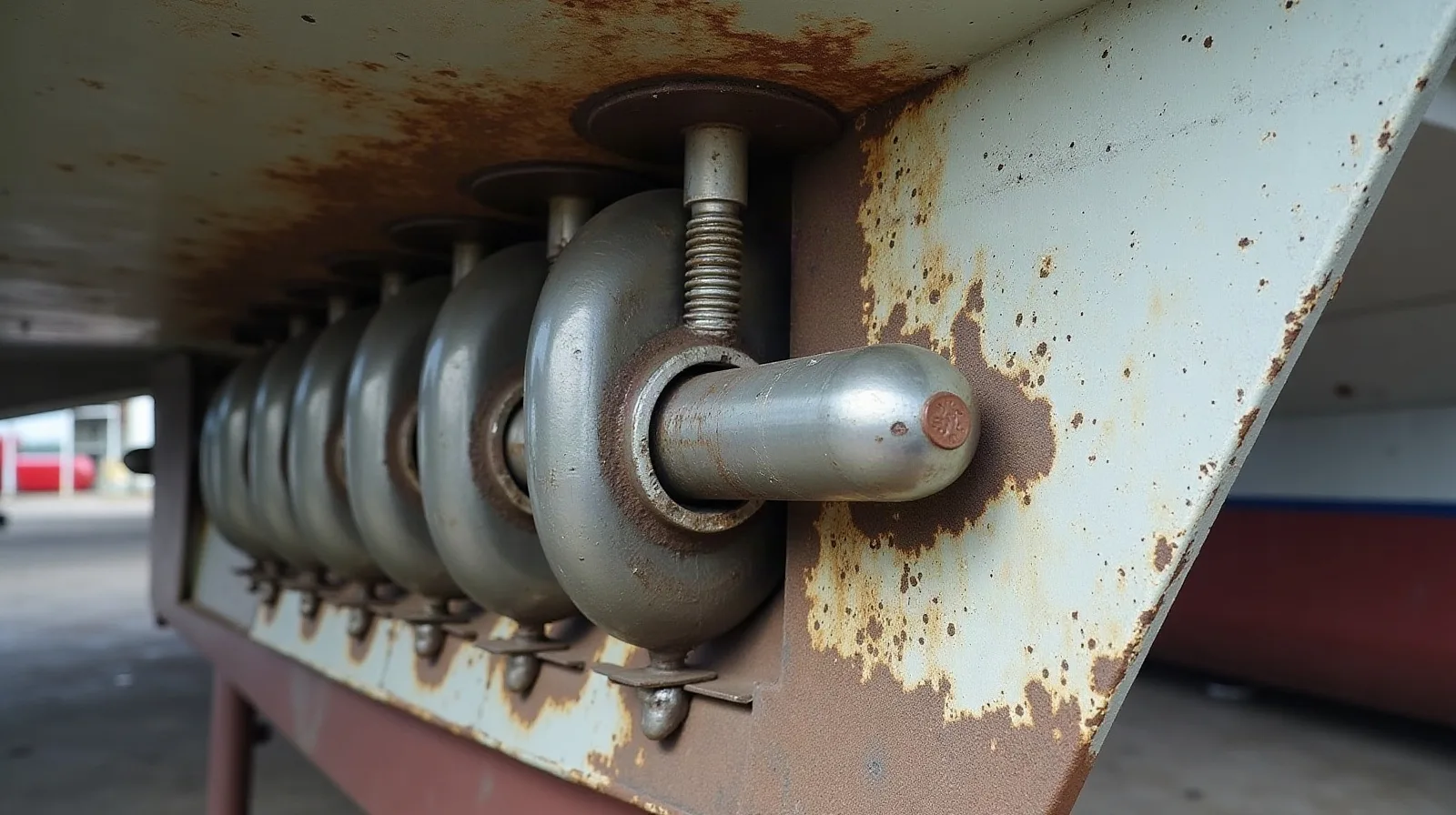
Galvanic corrosion on vessels occurs when two dissimilar metals are electrically connected in seawater: the more active metal corrodes to protect the more noble one. Steel hull plate, shafts and bronze fittings are the natural victims unless you fit sacrificial zinc or aluminum anodes. For early detection, watch anode wastage: too fast, or intact for years, both signal trouble.
Kendari Shipyard Desk put this guide together because galvanic damage is the damage that most often “surprises” vessel owners on the dry dock — even though it can almost always be read well in advance.
Where galvanic corrosion strikes most often
The vulnerable points are anywhere two dissimilar metals meet seawater: a bronze propeller on a steel shaft, sea valves and through-hull fittings, copper-nickel pipe connections to the engine block, the rudder and its stock, and steel plate around bronze fittings. On engine-powered wooden vessels, the areas around metal bolts and the shaft are actually the most critical — the surrounding timber is also damaged by the electrochemical process (delignification around metal acting as an active cathode), weakening the bolts’ grip.
Sacrificial anodes: the right rules
Choose the anode material to suit the water
For full-strength seawater such as the waters of Southeast Sulawesi and the Banda Sea: zinc or aluminum. Magnesium anodes are for fresh water only — in the sea they waste away uselessly within weeks. Aluminum is now widely used because it is lighter and works well in both seawater and brackish water.
Fit them with real electrical contact
An anode only works when it is electrically connected to the metal it protects. An anode bolted on over paint, or with a rusted mounting, is just decoration. The contact surface must be bare metal and tight, and — this is often forgotten — the anode itself must never be painted.
Read the wastage rate
| Anode condition at haul-out | What it means | Action |
|---|---|---|
| 30–70% consumed within a year | System working normally | Replace routinely at every docking |
| Almost fully consumed in < 6 months | Heavy galvanic load: a foreign metal is connected, or there is stray current | Find the source — don’t just add more anodes |
| Still intact after 1–2 years | Anode not connected / wrong material | Check the contact & anode type |
| Very fast, even wastage in one area | Local problem (e.g., shaft/propeller) | Add protection in that area, check bonding |
Stray current: turbocharged galvanic corrosion
The most aggressive damage comes not from natural metal pairings but from the vessel’s own electrical system. A DC installation leaking into the water — chafed cables in a wet bilge, carelessly grounded bilge pumps, twisted joints without solder — turns the hull into an active electrode. Stray-current corrosion can eat through fittings in weeks, not years. Its typical signs: very fast, localized damage, often near the source of the current leak, sometimes with clean pits that look as if they were drilled. Vessels that often berth at quays with shore power also need to check their grounding path. Because the root problem is electrical, it is resolved through an inspection of the installation — a service we coordinate through our marine electrical repair in Kendari page.
Galvanic checks while the vessel is on the dock
At every docking, set aside one hour just for this: record the condition of every anode (photograph it before removal), check for pitting on the plate around bronze fittings, check the bonding cables between major metal components, measure continuity from the anodes to the shaft and hull, and inspect the areas around bolts on wooden vessels. Pitting findings are followed up according to their depth — from a simple paint touch-up to plate replacement; that scope goes into the hull work on our hull repair and painting page.
How it relates to non-metal hulls
Fiberglass vessels are not immune: their shafts, propellers and metal fittings still interact with one another, and are often overlooked precisely because “the boat is plastic.” Speedboat and dive boat owners should read this alongside our article on fiberglass hull maintenance in tropical climates — two different problems that meet on the same vessel.
In short: anodes are the thermometer of your vessel’s galvanic health. Reading them at every haul-out costs nothing extra — ignoring them can end in replacing shafts, fittings or plate costing hundreds of times the price of an anode. In every dry-docking supervision, a galvanic inspection sheet is a standard part of our report, and we always present the estimate for remedial work in USD per item.
The galvanic series: understanding who eats whom
Every protection decision comes down to one simple table called the galvanic series: metals ranked from the most active (most easily corroded) to the most noble. Zinc and aluminum sit at the active end — which is why they are chosen as sacrificial anodes. Steel is in the middle; bronze, copper and stainless steel are on the noble side. The rule of thumb: the farther apart two metals are in the series, and the larger the surface area of the noble metal compared with the active metal, the more aggressive the corrosion. A large bronze propeller on a steel shaft is the classic pairing that explains why the stern area is always the hungriest for anodes. When adding new underwater equipment — transducers, intakes, fittings — always ask: what metal is this, and what will it be connected to?
Small habits that protect a vessel for years
Good galvanic protection is a collection of cheap habits: photograph every anode at every haul-out, with dates (this archive makes trends readable at a glance); replace anodes once they are more than half consumed rather than waiting until they are completely gone; never paint anodes or their contact surfaces; check the tightness of the anode bolts at every docking, because a loose mounting means dead protection; and every time electrical work is done on the vessel, retest for current leakage to the hull before the vessel returns to service. Add one more discipline for vessels that often berth at quays with shore power: make sure the vessel’s grounding path is in order and consider galvanic isolation on the shore-power connection. All of these habits cost almost nothing — and together they are the difference between a vessel whose fittings are replaced once a decade and one that donates new fittings to the chandlery every two years.
FAQ
Zinc or aluminum anodes for a vessel in seawater?
Both work in full-strength seawater; aluminum is now widely used because it is lighter and also effective in brackish water. What you must not use is magnesium in the sea, because it wastes away uselessly within weeks.
What does it mean when anodes waste away too fast?
An abnormal galvanic load: a foreign metal is connected to the system, the bonding is faulty, or there is stray current from a leaking electrical installation. Adding anodes without finding the source only delays the damage.
Do fiberglass vessels need anodes too?
Yes. Their shafts, propellers, trim tabs and metal fittings still interact electrochemically in seawater, and are often overlooked during inspections precisely because the hull is not metal.
Prepared by Kendari Shipyard Desk — specialist maritime brand under Juara Holding Group. Service contracts through PT Komodo Galangan Nusantara. Slot and estimate inquiries: WhatsApp 6281139414563 or bd@juaraholding.com.
Further reading
-
Fiberglass Hull Osmosis in the Tropics: Blisters and Gelcoat
Fiberglass hull osmosis — water slowly soaking into the laminate and raising blisters — is one of three tropical enemies of a fiberglass boat, together with sun-degraded gelcoat and careless…
-
Top Overhaul vs Major Overhaul: Decide by Running Hours
The top overhaul vs major overhaul decision is safest made from engine running hours, not gut feeling. Rule of thumb for mid-size marine diesels: top overhaul (cylinder heads, valves, injectors)…
-
Realistic Antifouling Interval for the Banda Sea
In the warm waters of eastern Indonesia, including the Banda Sea and around Wakatobi, antifouling works harder than almost anywhere else: year-round warmth makes barnacles, algae and shipworm grow fast,…