
Airbag Launching vs Slipway vs Graving Dock: Which Suits Your Vessel?
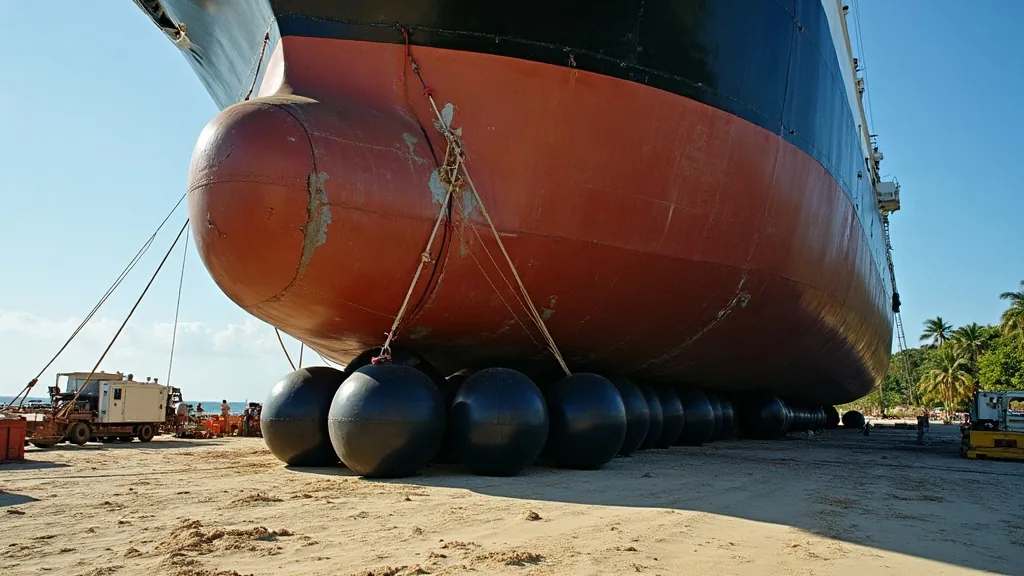
Airbag launching vs slipway is really a three-way choice, because the graving dock is the third method widely used in Indonesia. How a vessel is brought out of the water determines cost, time and the risk of structural damage, and each method — airbags, rail slipway and graving dock — suits a different situation.
The principle that applies to all three
Whatever the method, one thing determines hull safety: load distribution. A vessel is designed to be supported evenly by water across its entire wetted surface. Once it is brought ashore, that load transfers to a limited number of points. If there are too few points, or they are in the wrong place, the structure takes forces its designer never accounted for.
Damage from poor blocking often does not show immediately. It appears as permanent deformation, cracked joints, or doors and hatch covers that no longer close tightly. That is why the blocking plan should be part of the dry docking agreement, not a snap decision on site.
Rail slipway with a cradle
The vessel is hauled ashore on a cradle that runs on inclined rails. This method is the most common for mid-size workboats because the process is fast and repeatable and the support is relatively easy to control.
Its limits lie in cradle capacity and track width. Vessels that are too wide or too heavy cannot be served, and unusual hull shapes require keel block adjustments that add time. For the routine dry docking cycle of a working fleet, this method is usually the most efficient — how it applies is on the tugboat and barge page.
Airbags: flexible, but calculation-dependent
Pressurized airbags are placed under the hull, and the vessel is rolled up or down a gently sloping beach. The advantages are significant in Indonesian conditions: no expensive permanent structure is needed, the method can be used at many coastal sites, and it can handle large hulls.
Its weaknesses are technical and often underestimated. The number of bags, their working pressure and their spacing must be calculated from the hull’s weight and stiffness. Too few bags create point loads that press on the frames. Uneven pressure twists the hull. For a half-finished hull whose bulkheads and deck are not yet complete, this risk is far greater — something we cover in the article on moving an unfinished hull.
Graving dock
A gated basin that is pumped dry after the vessel enters. It gives the fullest control: the entire hull is accessible, blocking can be set precisely, and work is not limited by the tide. The trade-off is a higher slot cost and limited availability.
Comparison
| Aspect | Slipway | Airbag | Graving dock |
|---|---|---|---|
| Availability in eastern Indonesia | Common | Common | Limited |
| Blocking control | Good | Depends on calculation | Very good |
| Cycle speed | Fast | Moderate | Moderate |
| Size limit | Cradle capacity | Flexible | Basin dimensions |
| Main risk | Keel blocks not matched to hull shape | Point loads on frames | Slot queue |
Planning the blocking before the vessel comes out
A blocking plan is a document owners rarely ask for and almost always worth having. Its contents are simple: the position of the keel blocks or airbags relative to the vessel’s structure, the estimated load at each point, and the reason each point was chosen.
The right positions follow the structure, not the convenience of the workers. Load should be carried under bulkheads, heavy frames or longitudinal stiffeners, not in the middle of a plate panel or plank with nothing behind it. For a vessel that has been hauled out before, the previous positions should be reused so the same area does not take repeated stress at different points.
Asking for this plan before the vessel is lifted takes a few minutes and prevents damage whose cost can exceed the entire dry docking job.
Different risks for each method
Each method has its own typical failure mode, and knowing them helps the owner ask the right questions.
On a slipway, the main risks are keel blocks that do not match the hull shape, so the load becomes concentrated, and a poorly maintained cradle. The right question: have the blocks been adjusted to this vessel’s hull shape?
With airbags, the main risks are a number and pressure of bags that have not been calculated, and an uneven beach surface that changes the load distribution as the vessel moves. The right question: how many bags will be used, at what pressure, and on the basis of what calculation?
In a graving dock, the technical risk is the lowest but the schedule risk is the highest, because slot availability is limited and a delay to one vessel pushes back the queue behind it.
For a half-finished hull, all three risks increase because the structure is incomplete, as discussed in the article on moving an unfinished hull.
Questions worth asking before agreeing to a dock slot
Before agreeing to a lifting schedule, four short questions reveal most of the risks an owner needs to know about.
Which method will be used for this vessel, and why that method was chosen. What the blocking plan is, and whether the support points follow the vessel’s strong structure. Whether they have handled vessels of similar size, weight and hull shape. And what the plan is if the weather or the tide is unfavorable on the scheduled day.
Answering all four requires no complicated technical terms. What is being judged is not how sophisticated the answers are, but whether the people who will lift your vessel have thought about these things before it arrives, or will only think about them once the crane is ready.
Choosing for your vessel
For mid-size steel workboats on a routine docking cycle, a slipway is usually the most economical choice. For large hulls, unusually shaped hulls, or sites without permanent facilities, airbags offer flexibility no other method has — provided the calculations are done seriously. For heavy work that demands full access and long working time, a graving dock is worth its cost.
For wooden hulls, the main consideration is not the method but how evenly the hull is supported, because wood is far more sensitive than steel to concentrated support. The treatment of wooden hulls is explained on the phinisi and wooden vessel page, and the scope of dry docking work in general on the dry docking and repair page.
Frequently Asked Questions
Is airbag launching safe for large vessels?
Yes, if the number, pressure and spacing of the bags are calculated to match the hull’s weight and stiffness. The risk arises when the load is concentrated on a few points, putting excessive pressure on the frames.
Why is a graving dock more expensive?
Because it is a permanent structure that is expensive to build and maintain, and its availability is limited, so its slots are in high demand. What you are really paying for is full control over working conditions.
Which method is best for a wooden hull?
The one that distributes the load most evenly. Wooden hulls are very sensitive to concentrated support, so thorough, even blocking matters more than the type of method.
Further reading
-
Annual Dry Docking Budget and Schedule: What Vessel Operators Must Plan For
Dry docking is a predictable expense, yet most operators treat it as an annual surprise. This article sets out an annual dry docking budget framework that turns that spending into…
-
Boat Building Cost in Indonesia vs Vietnam vs Turkey: A Buyer’s Reality Check
Judging boat building cost — Indonesia vs Vietnam vs Turkey — by headline price is the fastest way to reach the wrong conclusion. Total delivered cost is determined by factors…
-
Liveaboard Vessel ROI: An Honest Way to Calculate Charter Vessel Returns
Charter vessel investments are often judged with models that are too optimistic on revenue and too light on costs. This article sets out a more honest framework for calculating liveaboard…